Down vs Synthetic Fill for Puffer Jackets
Compare down vs synthetic fill for puffer jackets from our Sialkot factory. Warmth, wet weather, quilting, 40 to 50 GSM bubble shell, and 50-piece MOQ.
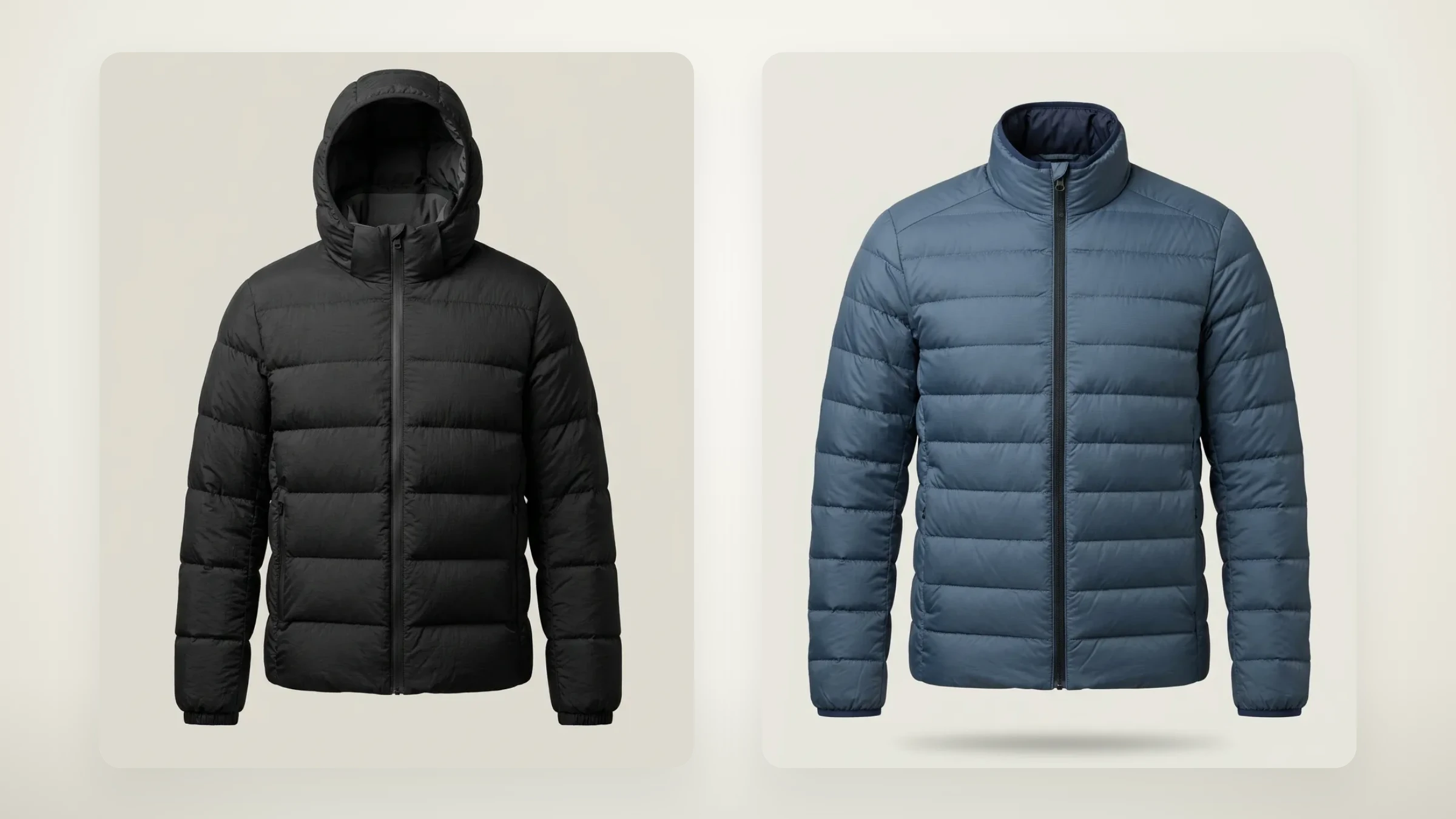
Choosing between down vs synthetic fill for puffer jackets shapes your unit cost, warmth rating, target climate, and care instructions before a single pattern is cut. Duck down delivers the highest warmth-to-weight ratio and packs down small, while synthetic polyester fill retains heat in wet weather and costs less to produce at scale.
At BROXAIL in Sialkot, Pakistan, we manufacture private-label insulated puffer jackets using both duck down and synthetic polyester fill, starting at an MOQ of 50 pieces per style and design with a tech pack free with order. This guide breaks down how each insulation behaves on the cutting table, inside baffles, and in your customers’ hands.
Key takeaways
- Both Fills Offered: BROXAIL manufactures custom puffer jackets using either duck down fill or synthetic polyester fill starting at 50 pieces per style and design.
- Confirmed Shell Standard: Standard shells use 40 to 50 GSM bubble fabric; thinner 40D or lighter ripstop is used only when a buyer specifically requests ultralight packables.
- Climate Trade-Off: Duck down delivers lighter warmth-to-weight and small pack size for cold dry air, whereas synthetic polyester retains heat in rain and washes easily.
- Low-MOQ Terms: Tech pack free with order, 7 to 10 days for standard sampling (complex multi-baffle styles longer), and about 3 weeks for bulk after approval.
How Do Down and Synthetic Fill Work Inside a Puffer Jacket?
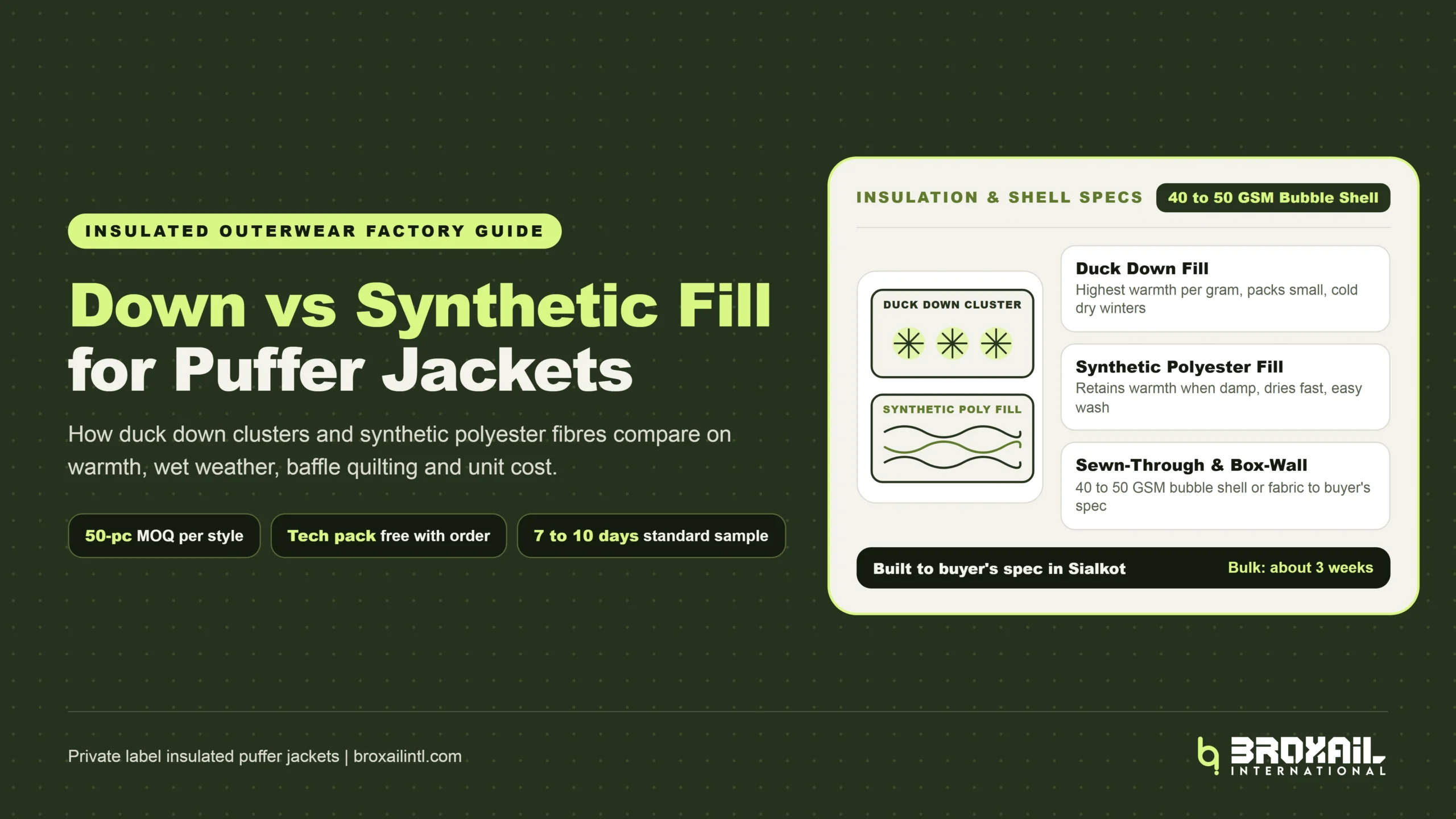
Both insulation types keep a wearer warm in the same basic way: they trap tiny pockets of still air that slow down body heat loss. The difference lies in how the fibres create and hold that trapped air.
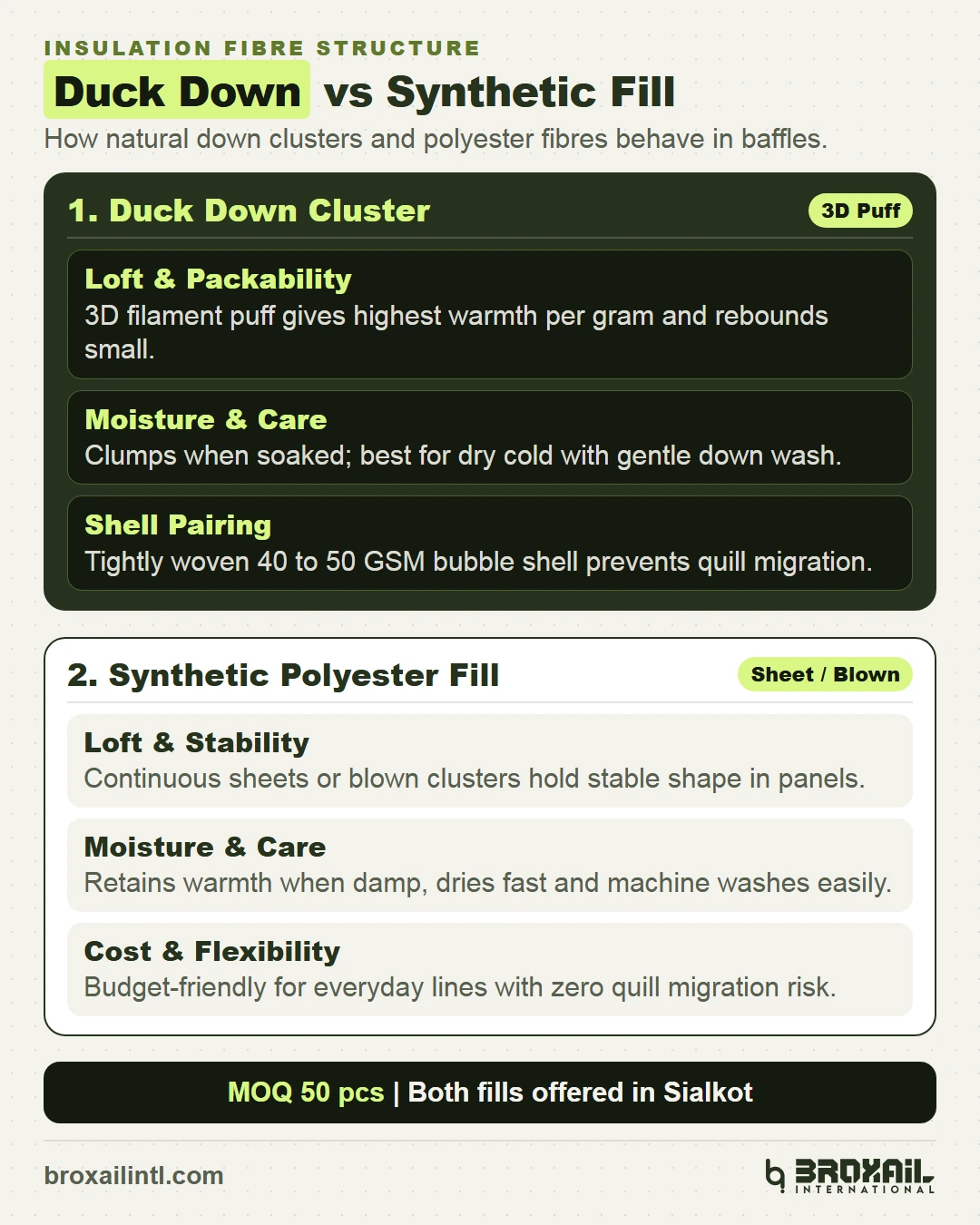
Duck down comes from the soft under-plumage beneath a bird’s outer feathers. Each down cluster forms a three-dimensional puff of fine filaments that expands into thousands of tiny air pockets. Because those clusters spring back after compression, down traps a high volume of warm air for very little weight.
Synthetic fill uses man-made polyester fibres engineered to mimic the loft of natural down. Factories use either continuous-filament sheets or loose blown polyester clusters. Continuous sheets hold their shape easily inside quilted panels, while blown synthetic fibres behave more like natural down during filling.
Down vs Synthetic Fill for Puffer Jackets: Warmth, Weight, Care, and Price
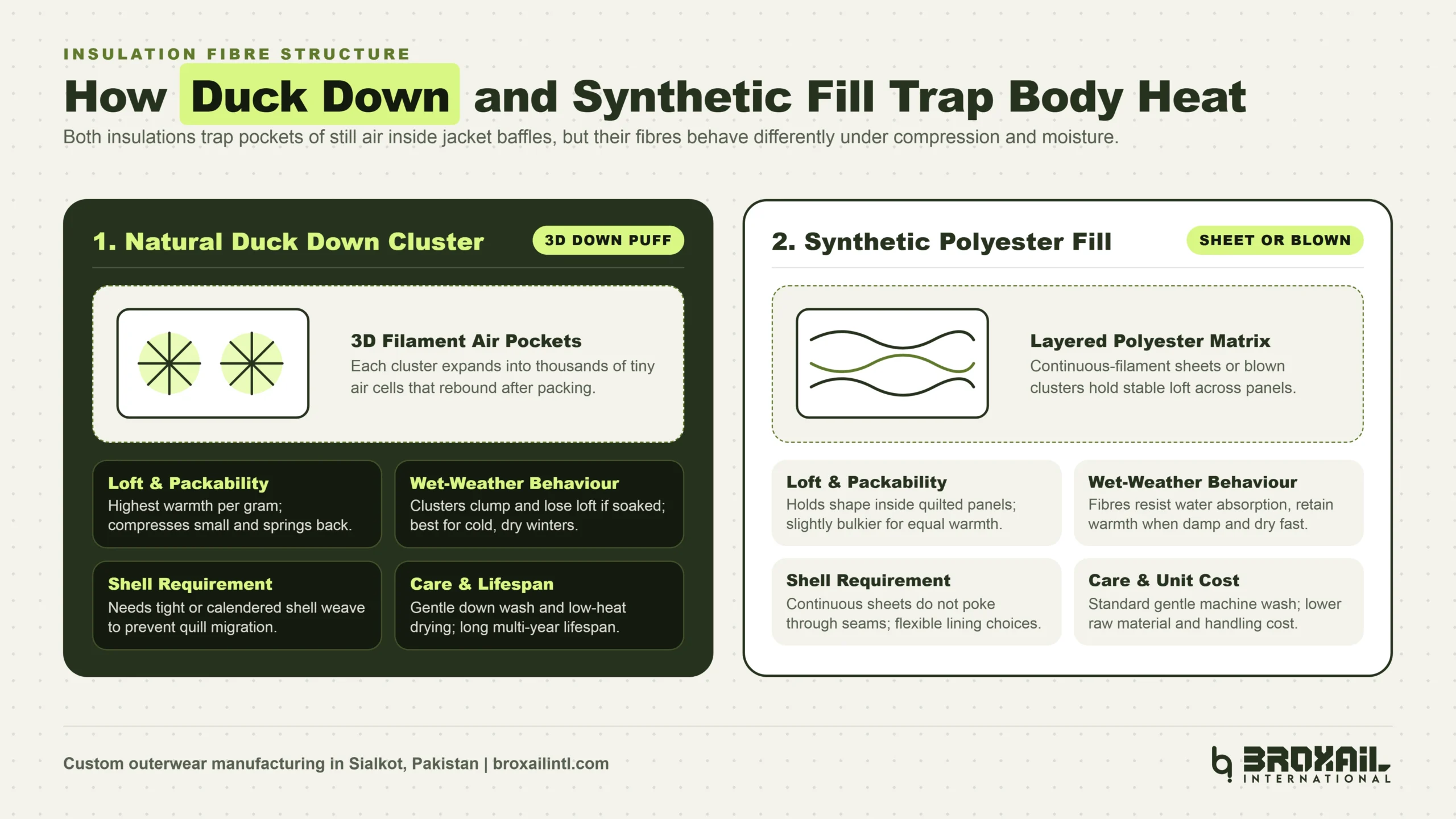
Natural duck down achieves strong warmth-to-weight ratio, packability, and multi-year lifespan, whereas synthetic polyester fill wins on wet-weather warmth, lower upfront cost, and easy machine washing. Independent cold-weather gear guides from REI Expert Advice and OutdoorGearLab confirm this core trade-off across travel, coastal, and alpine climates. Your choice depends on where your customers wear the jacket and the retail price point you want to hit.
When natural down gets soaked, the clusters clump together, lose their loft, and stop trapping warm air until they dry out. Synthetic polyester fibres absorb far less water, keep most of their loft when damp, and dry much faster in humid or rainy climates.
| Performance Factor | Duck Down Fill | Synthetic Polyester Fill |
|---|---|---|
| Warmth-to-weight ratio | Highest warmth per gram of fill | Heavier and bulkier for equal warmth |
| Wet-weather performance | Clumps and loses loft when wet | Retains warmth when damp and dries fast |
| Packability | Compresses very small and rebounds | Bulkier in a pack or travel bag |
| Upfront manufacturing cost | Higher raw material and handling cost | More budget-friendly for most lines |
| Care and washing | Requires gentle down wash and low-heat drying | Standard gentle machine wash and care |
| Lifespan under normal care | Long-lasting if kept clean and dry | Fibres flatten slowly over years of compression |
For brands selling into cold, dry winters or travel-focused wardrobes, a packable lightweight down puffer jacket justifies a higher retail price. For rainy coastal markets, workwear, or entry-level winter drops, synthetic polyester fill protects your margin and reduces customer care issues.
Which Quilting and Baffle Construction Suits Each Fill?
The stitching pattern that holds your insulation in place affects warmth just as much as the fill itself. Factories build puffer jackets using two main baffle methods: sewn-through quilting and box-wall construction.
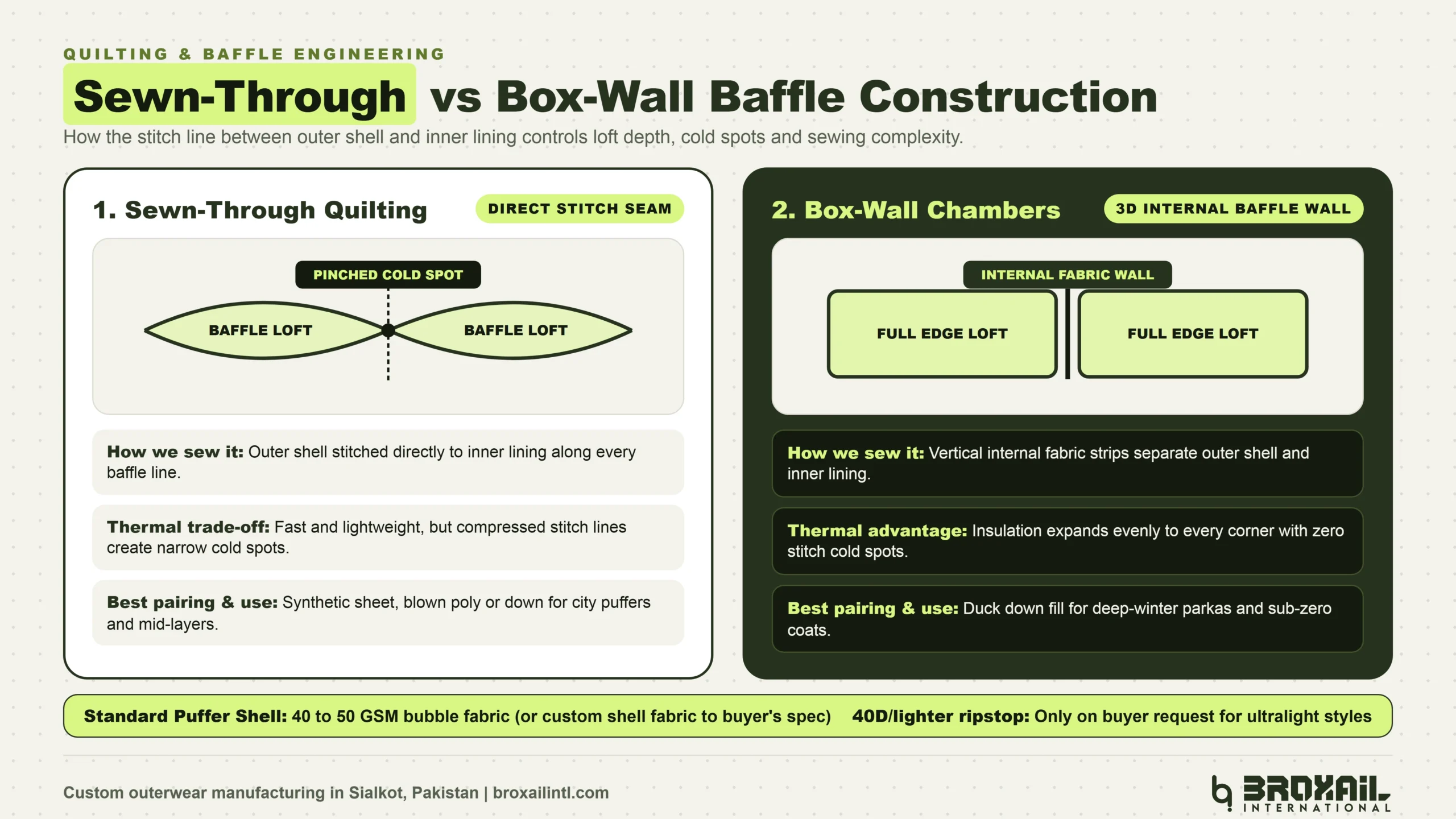
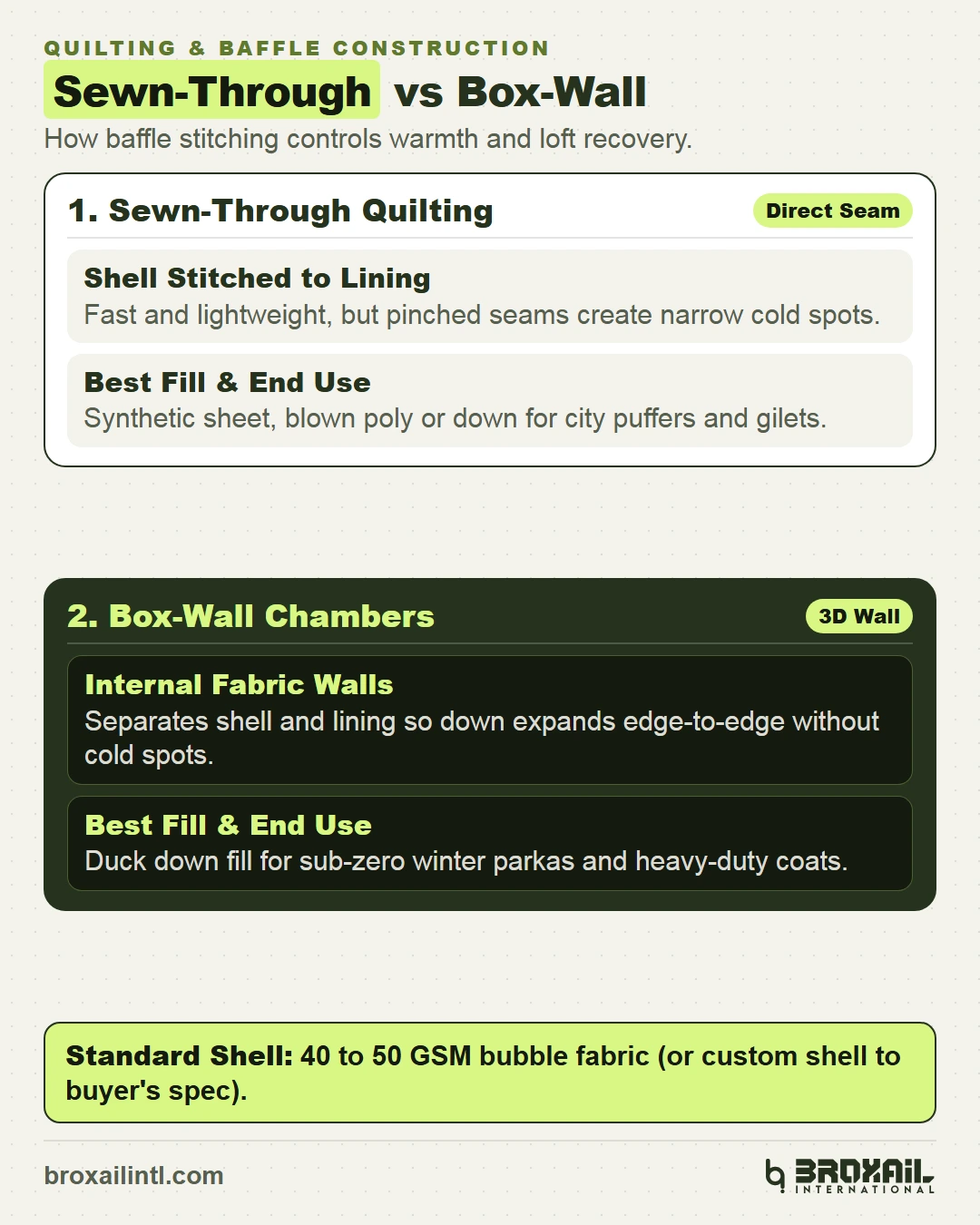
In sewn-through construction, the outer shell and inner lining are stitched directly together along every baffle line. This method is fast to sew, keeps garments lightweight, and works well for everyday winter puffers and active mid-layers. Its trade-off is that compressing the fill at the stitch line creates narrow cold spots where heat can escape.
In box-wall construction, machinists sew vertical internal fabric strips between the outer shell and the lining to form three-dimensional chambers. Because the shell and lining never pinch together at the seam, the fill expands evenly to every corner of the baffle. Box-wall chambers eliminate stitch-line cold spots for deep-winter down parkas, though the extra internal fabric adds weight and sewing time.
| Construction Choice | How We Sew It | Best Fill Pairing | Ideal End Use |
|---|---|---|---|
| Sewn-through horizontal baffles | Shell stitched directly to lining | Synthetic sheet, blown poly, or duck down | Everyday city puffers and lightweight layers |
| Box-wall chambers | Internal fabric walls separate shell and lining | Duck down fill | Sub-zero winter parkas and heavy-duty coats |
| Diamond or channel quilting | Tighter stitch grid across body panels | Synthetic sheet fill | Liner jackets, workwear gilets, and fashion puffers |
If you specify loose duck down or blown synthetic clusters, our pattern room also plans chamber fill weights per panel so insulation stays evenly distributed across the chest, back, sleeves, and hood.
What Shell Fabric Works Best for Puffer Jackets?
Your outer shell fabric controls wind resistance, down-proofing, tear strength, and the final hand-feel of the garment. At BROXAIL, our confirmed standard puffer shell is bubble fabric at 40 to 50 GSM, which gives brands a clean matte or semi-matte surface, reliable wind blocking, and smooth drape over quilted baffles.
You can see how this shell sits on a finished silhouette on our bubble fabric hooded puffer jacket product page. Other outer fabrics, linings, and trims are sourced to buyer’s specification, so we match your tech pack if your collection calls for a heavier weather-resistant weave or a specific lining finish.
We do not use 40D or lighter ripstop shells as our standard option because those ultra-thin weaves tear too easily during everyday wear. We only run 40D or lighter ripstop if a buyer specifically requests an ultralight packable style and signs off on the lighter fabric weight during sampling.
For down-filled styles, the shell and lining weave must also be tightly constructed or calendered to prevent fine down quills from poking through the seams. Synthetic continuous-sheet insulation removes that migration risk, which gives designers more freedom when choosing textured or softer lining fabrics.
When Should Your Brand Choose Down vs Synthetic Fill?
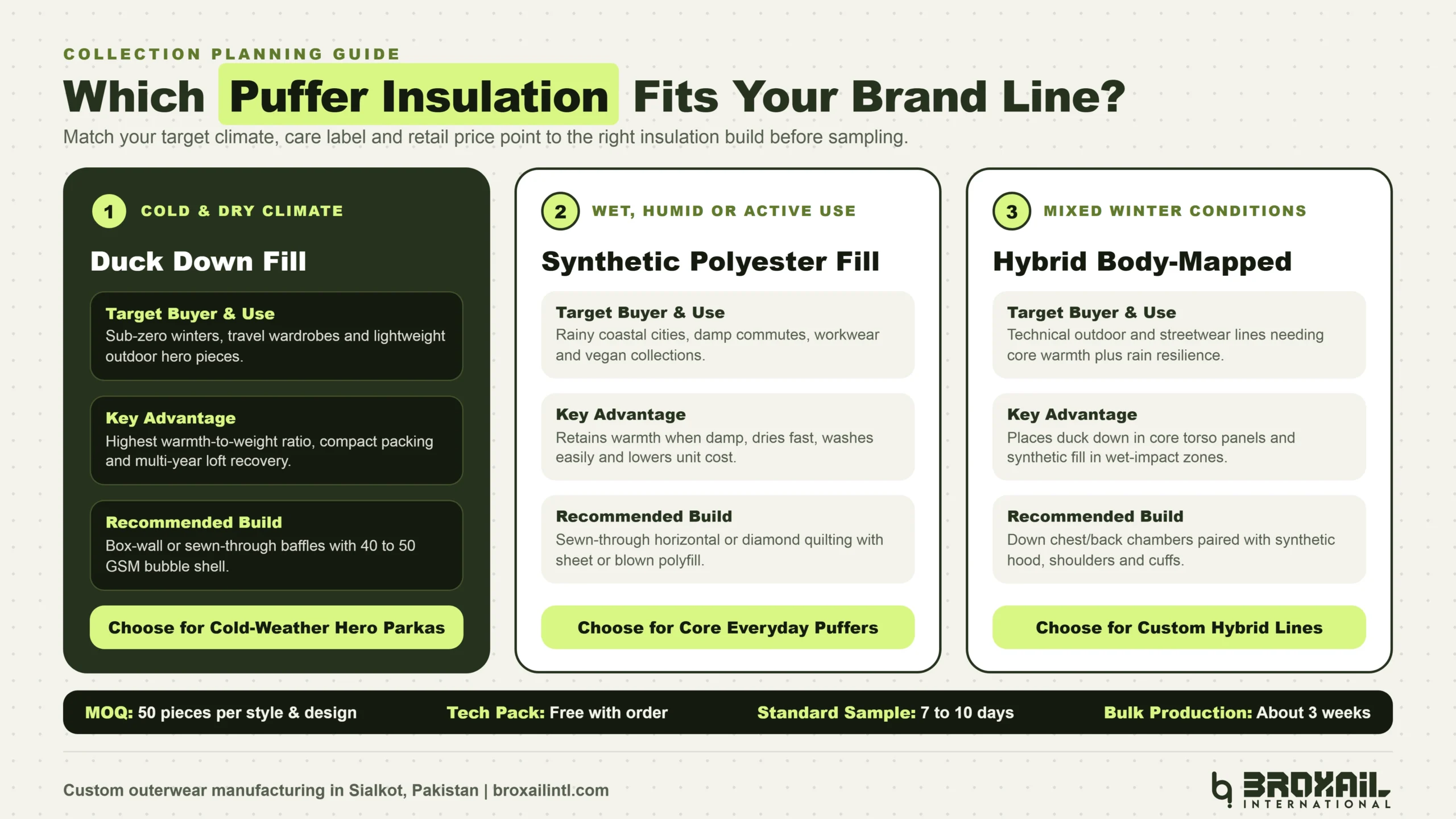
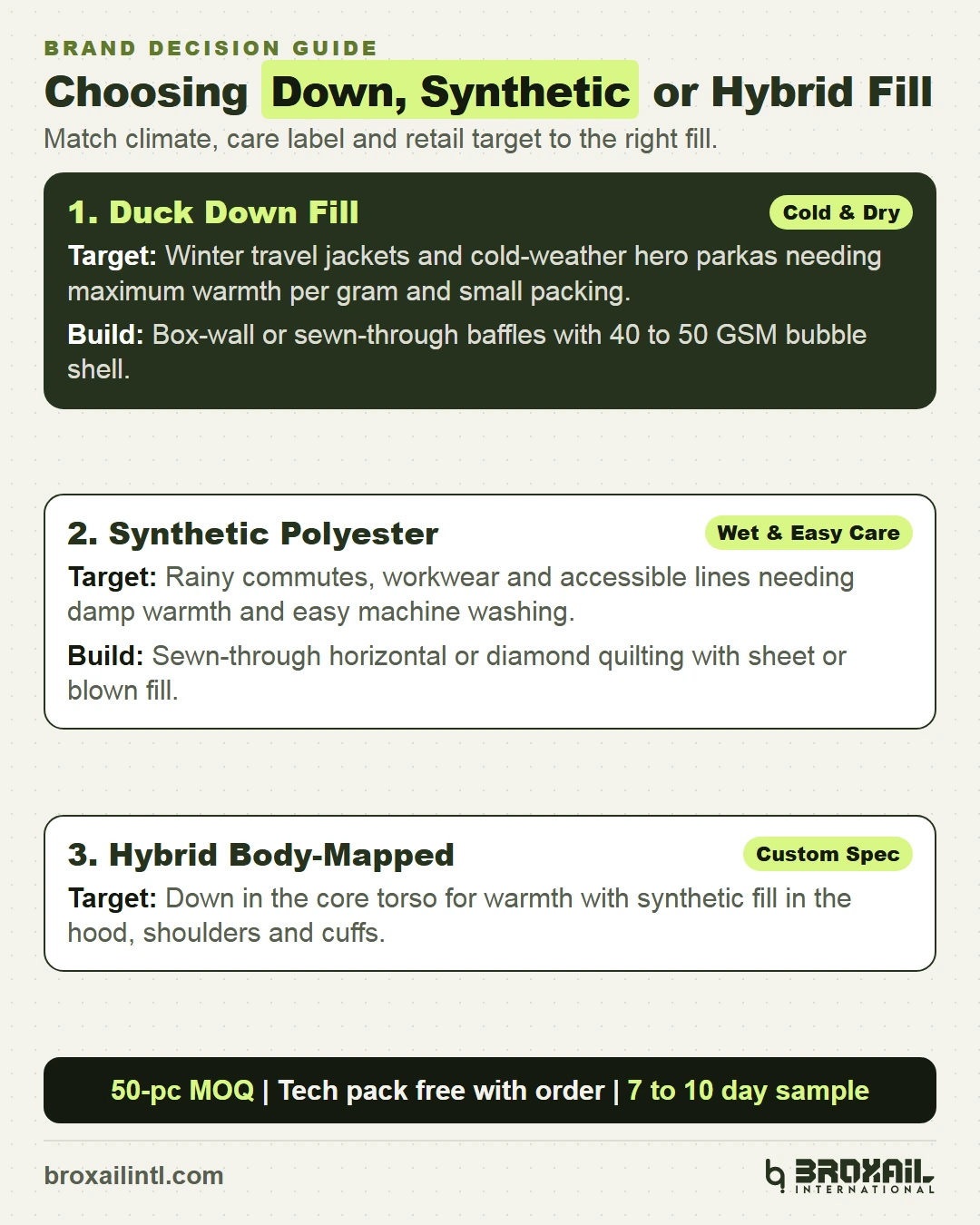
Choose duck down when your buyer values light weight, compact packing, and maximum warmth in cold, dry weather. Down works well for winter travel jackets, heritage outdoor lines, and higher-ticket seasonal hero pieces where customers expect natural loft and long wear life.
Choose synthetic polyester fill when your customers face rain, sleet, wet snow, or high-output movement where sweat builds up inside the jacket. Synthetic fill also fits brands targeting accessible retail prices, vegan or animal-free positioning, or straightforward machine-washable care labels.
Many growing brands run both options within one winter collection:
- Core everyday puffer (synthetic fill): Keeps unit cost predictable, handles damp city commutes, and washes easily at home.
- Cold-weather hero parka (duck down fill): Targets dry sub-zero markets with lower garment weight and strong loft.
- Hybrid body-mapped jacket (to buyer’s spec): Places down in the core torso for warmth and synthetic fill in the hood, shoulders, or cuffs where rain and sweat hit first.
How Does Puffer Jacket Sampling and Production Work at BROXAIL?
We build every puffer style to your specification with a low MOQ of 50 pieces per style and design, split across your chosen size run. Every production order includes a tech pack free with order drafted by our in-house pattern team, covering measurements, baffle spacing, shell fabric, and trim placement.
Standard puffer samples take 7 to 10 days to complete once fabrics and trims are confirmed. Complex styles, imported shell fabrics, or custom-made trims and hardware take longer, depending on the construction details of the piece.
After you approve the physical sample, bulk production takes about 3 weeks. We ship to more than 40 countries and support both delivery models: most new brands choose door-to-door shipping where we arrange delivery straight to their warehouse or studio, while larger brands book their own freight on FOB terms. You can review each stage in detail on our clothing manufacturing process page.
Frequently asked questions
What is the minimum order quantity for custom puffer jackets?
Our minimum order quantity is 50 pieces per style and design across all ranges, including both duck down and synthetic-filled puffer jackets. You can split those 50 pieces across your size run.
Can BROXAIL manufacture both duck down and synthetic puffer jackets?
Yes. We offer both duck down fill and synthetic polyester fill for insulated puffer jackets and gilets, alongside our standard 40 to 50 GSM bubble fabric shell or custom shell fabrics to buyer’s spec.
Which fill is warmer for its weight, down or synthetic?
Duck down provides a higher warmth-to-weight ratio than synthetic polyester fill and packs down smaller. Synthetic fill requires slightly more bulk for the same warmth, but it keeps insulating if the jacket gets damp.
How long do puffer jacket samples and bulk orders take?
Standard styles take 7 to 10 days for sampling. Complex multi-panel designs, imported materials, or custom hardware take longer depending on the garment. Bulk production takes about 3 weeks after you approve the sample.
Do I need to supply my own tech pack before requesting a quote?
No. BROXAIL provides a tech pack free with order. Send your reference photos, sketches, target fill type, and size range, and our pattern room will prepare the measurements and baffle layout for your sign-off.
Ready to Sample Your Puffer Collection?
Send us your style references, target fill type, and size breakdown to get a clear factory quote and sampling timeline. Request a quote with our Sialkot team to start your 50-piece puffer production run.

Written by
Muhammad Abubakar
Muhammad Abubakar runs BROXAIL International, a custom leather and textile apparel manufacturer in Sialkot, Pakistan. He works with brands, labels and wholesalers from the first sample to delivery.