Custom Work Coverall Manufacturer Guide
Work with a Sialkot coverall manufacturer. Learn custom coverall fabrics, front zips, reflective tape, sizing ease, 50-piece MOQ and 7 to 10 day sampling.
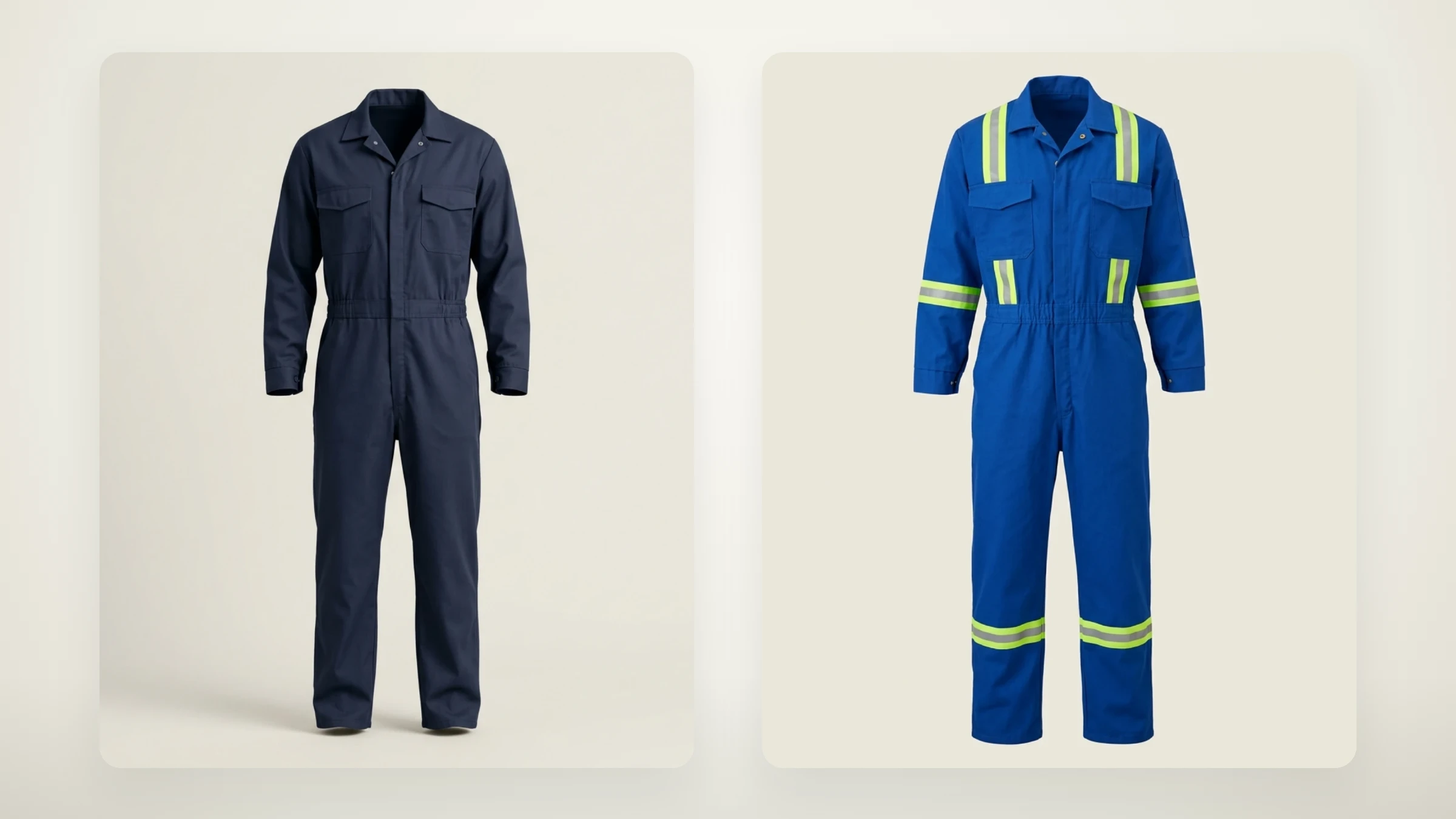
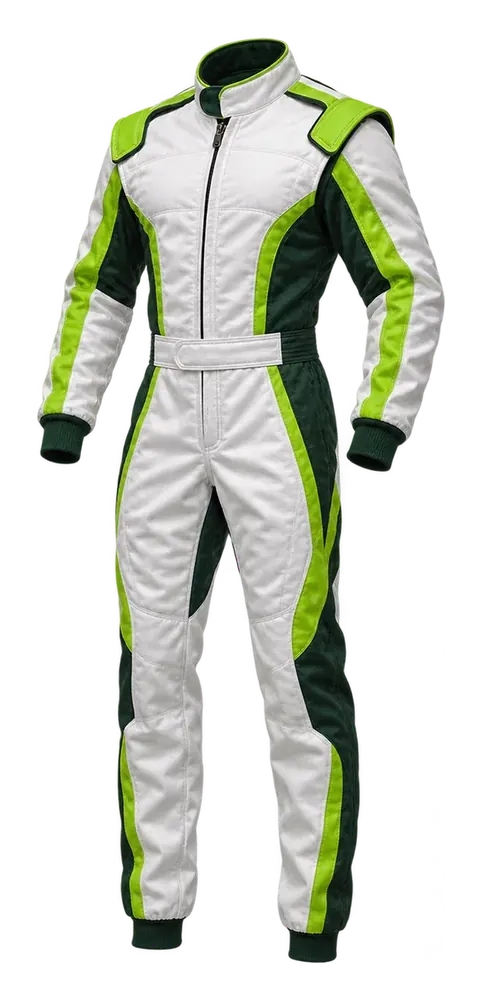
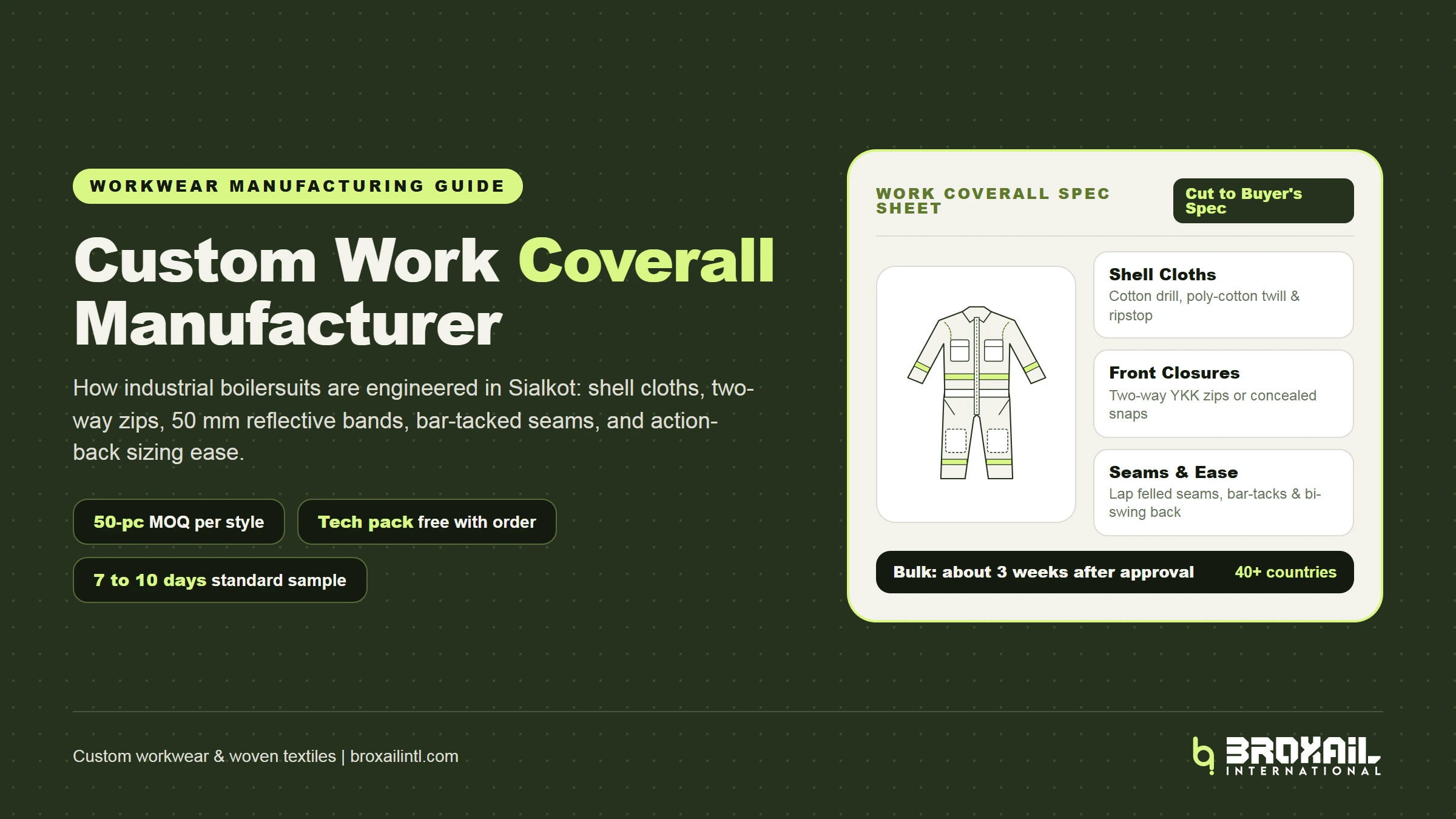
Manufacturing industrial work coveralls requires balancing dense shell cloth, front fasteners, retroreflective bands, and dynamic torso ease so trade crews move safely on job sites. As a specialised coverall manufacturer in Sialkot, Pakistan, BROXAIL International produces custom work coveralls, boilersuits and protective trade apparel starting at 50 pieces per style and design, supported by a tech pack free with order and 7 to 10 day standard sampling.
Unlike separate jackets and trousers, a one-piece coverall anchors at both shoulders and crotch. If seam allowances, zipper plackets or pleats are drafted incorrectly, the garment binds during reaching or splits at the seat during deep crouching. Understanding factory production variables helps sourcing teams build durable workwear to buyer specifications.
Key takeaways
- Shell & Closure Engineering: Cotton drill, poly-cotton twill, or ripstop shells cut to buyer spec, paired with two-way YKK front zips or concealed scratch-free press-stud plackets.
- Triple-Stitched Durability: Lap felled seat and crotch seams, dense bar-tacks at tool pockets, and knee pad pockets withstand heavy daily trade wear.
- Action-Back Pattern Ease: Bi-swing shoulder pleats give up to 60 mm dynamic reach expansion while torso length grading keeps knee pads aligned.
- Low-MOQ Terms: 50 pieces per style and design, tech pack free with order, 7 to 10 days standard sample (custom hardware longer), and about 3 weeks bulk.
What shell fabrics work best for custom work coveralls?
Work coverall shell fabrics are cut and sourced to buyer’s spec, with selection based on trade environment, climate and wash durability.
Pure cotton drill provides breathable comfort for mechanics and workshop technicians operating in warm conditions. Natural cotton fibres absorb perspiration and resist melting from sparks. However, cotton shrinks during hot laundering unless sanforised, and dark shades can fade under repeated chemical washes.
Poly-cotton twill blends, detailed in Standard Textile industrial workwear fabric specifications, balance abrasion resistance, tensile strength and colour fastness for commercial laundries. Adding polyester lowers shrinkage and keeps dark navy, black or petroleum blue shades bright across industrial wash cycles. For outdoor crews, ripstop textiles with grid reinforcement stop punctures from snagging into tears.
Per factory policy, fabric specifications, flame-retardant finishes and mill test reports are agreed with each buyer. We do not make blanket compliance claims; instead, we source mill lots to buyer’s spec and supply laboratory test reports upon agreement, such as on our flame-resistant work coveralls style.
| Fabric Option | Construction and Feel | Primary Trade Suitability | Specification Standard |
|---|---|---|---|
| 100% Cotton Drill | Breathable, natural spark resistance, soft hand | Automotive shops, indoor workshops, hot climates | Cut to buyer’s spec |
| Poly-Cotton Twill Blend | High tensile strength, shrink resistant, colorfast | Industrial plants, transport, maintenance fleets | Cut to buyer’s spec |
| Ripstop Grid Shell | Lightweight, high tear strength, puncture arresting | Utilities, outdoor contractors, surveying teams | Cut to buyer’s spec |
How do two-way front zips compare with concealed snap plackets?
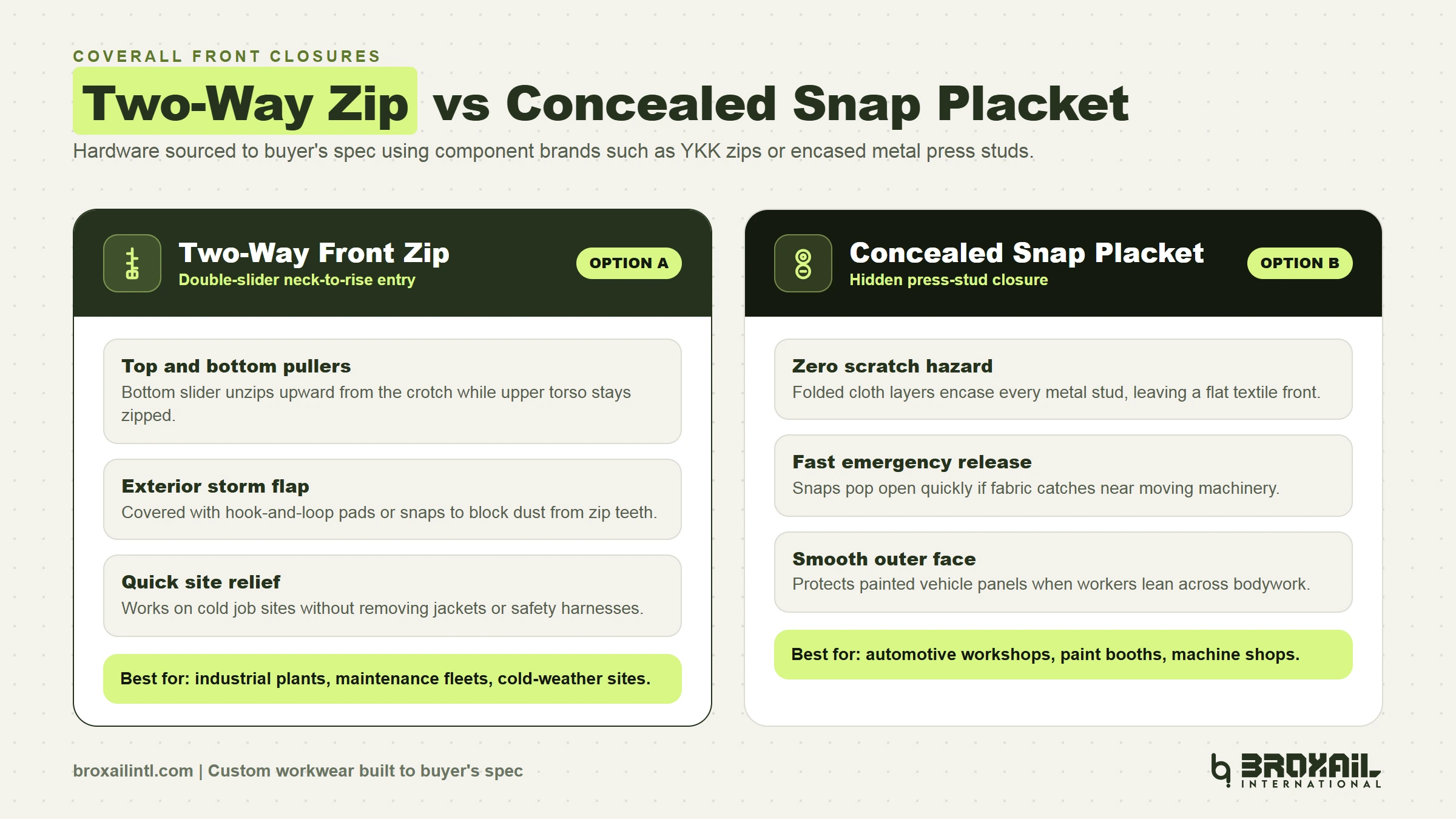
The front closure determines how quickly a worker steps into the coverall and whether the garment creates contact scratches on delicate equipment surfaces. At BROXAIL, all front closures use component brands such as YKK zips or metal snaps sourced to buyer’s spec.
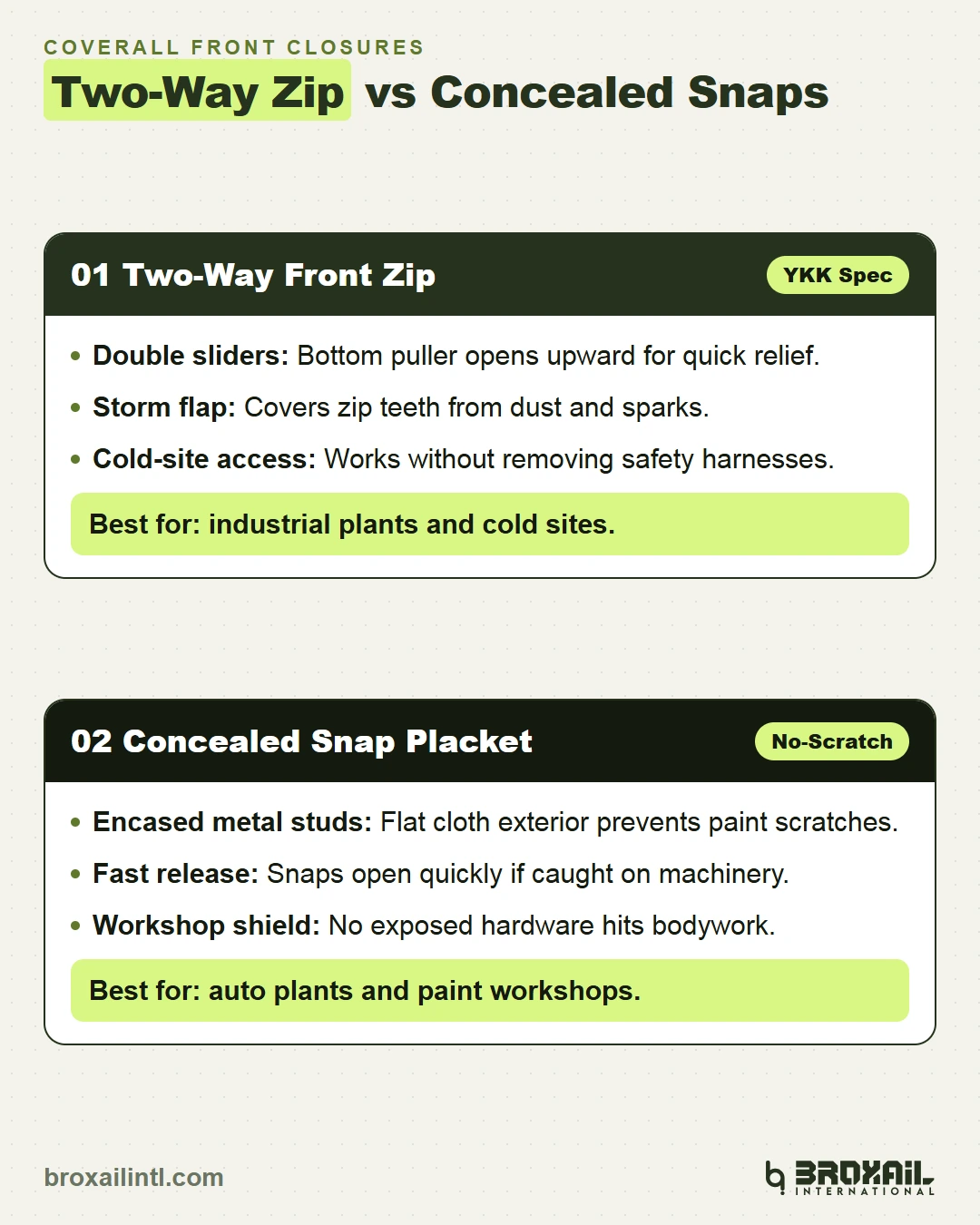
A full-length two-way front zip runs from neck to lower rise. With double sliders, the bottom puller unzips upward from the crotch while the top puller stays closed, allowing quick washroom relief on cold job sites without removing upper layers or harnesses. Two-way zips pair with an exterior storm placket lined with hook-and-loop pads or concealed snaps to keep dust out of the teeth.
Concealed press-stud plackets replace exposed zips in automotive plants where workers lean over finished vehicles. A concealed snap placket encases every metal stud inside folded fabric layers, leaving a flat cloth exterior that prevents exposed teeth from scratching automotive paint. Snaps also permit fast emergency release if a garment snags on moving machinery.
Which pocket layouts and seam reinforcements do work coveralls require?
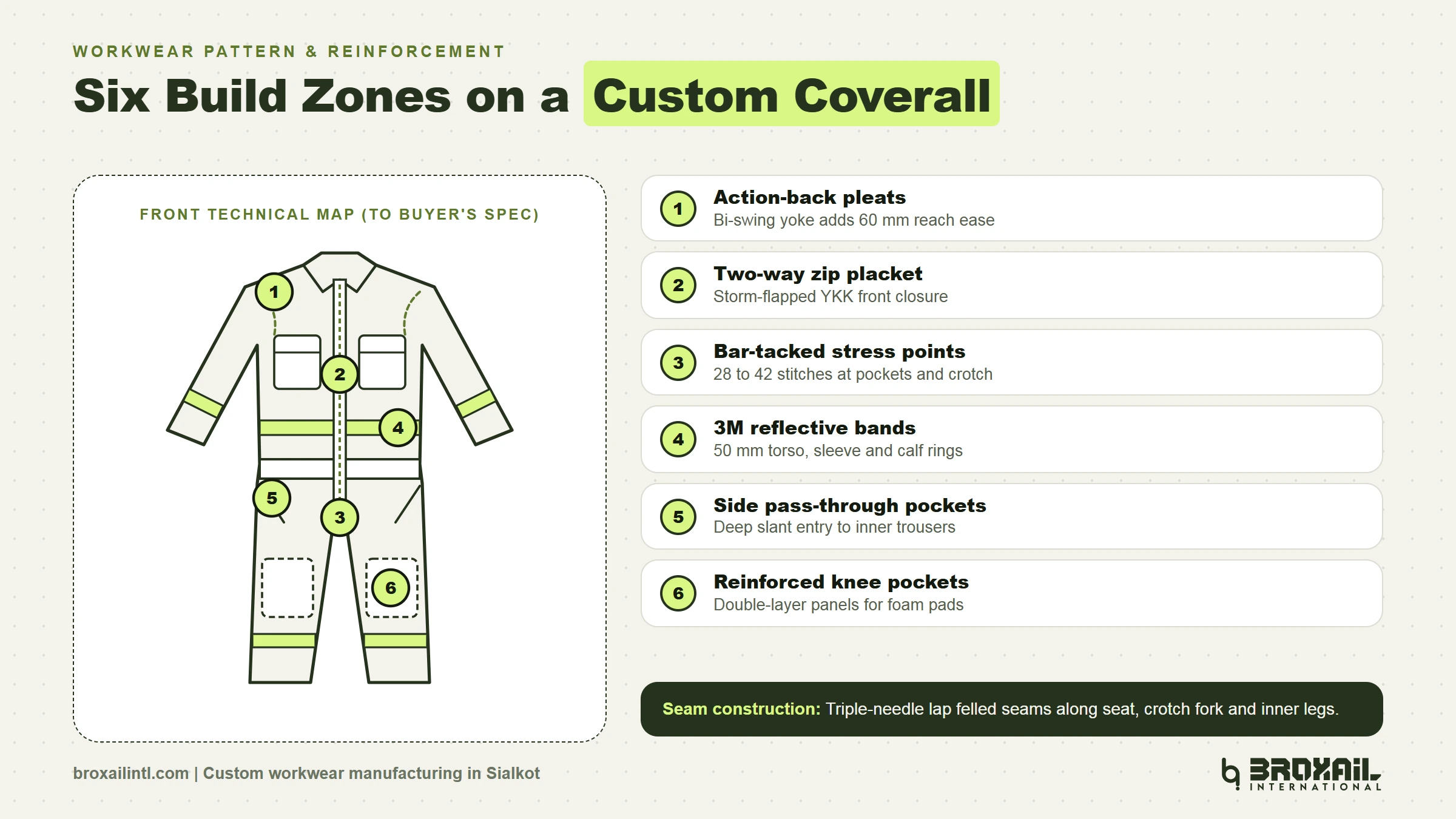
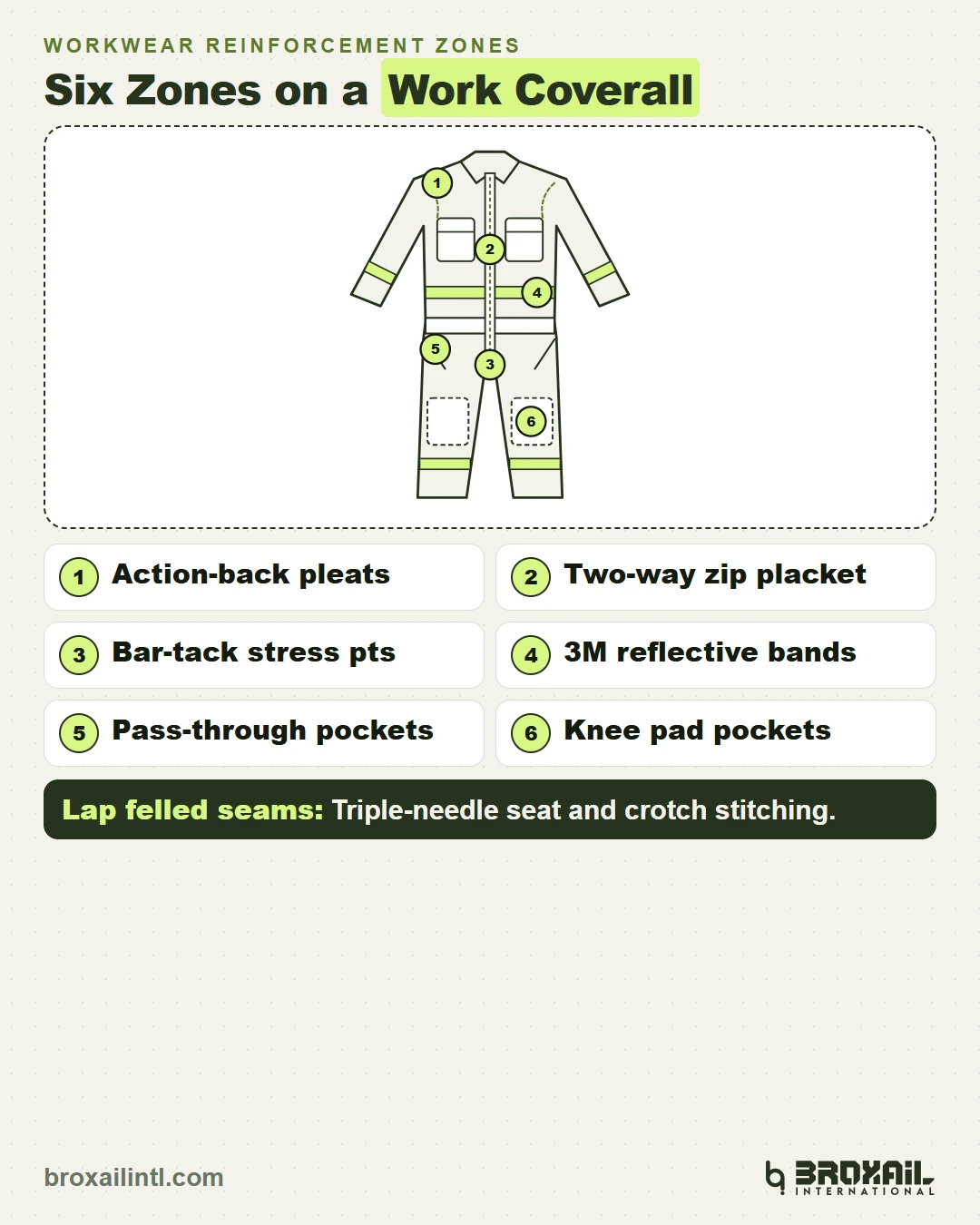
Industrial coverall pocket placement balances functional tool access with seam longevity under heavy mechanical strain. Chest pockets pair a zippered vertical pocket for phones with a flapped patch pocket for pens and gauges. Deep side slant pockets provide quick access, paired with internal pass-through slits that reach trousers worn underneath. Rear patch pockets use double-folded top hems and bar-tacked corners, while the right leg incorporates a narrow tool pocket for folding rules or spanners.
Reinforcement techniques separate trade workwear from casual clothing. Sialkot factories apply triple-needle lap felled seams along the seat, crotch fork and inner legs, folding fabric edges into an interlocking chainstitch. High-stress points receive dense bar-tacking of 28 to 42 stitches across pocket corners, zipper stops and crotch joins. In addition, front legs feature double-layer knee panels with bottom hook-and-loop openings for inserting foam knee pads.
How is reflective tape applied for industrial visibility?
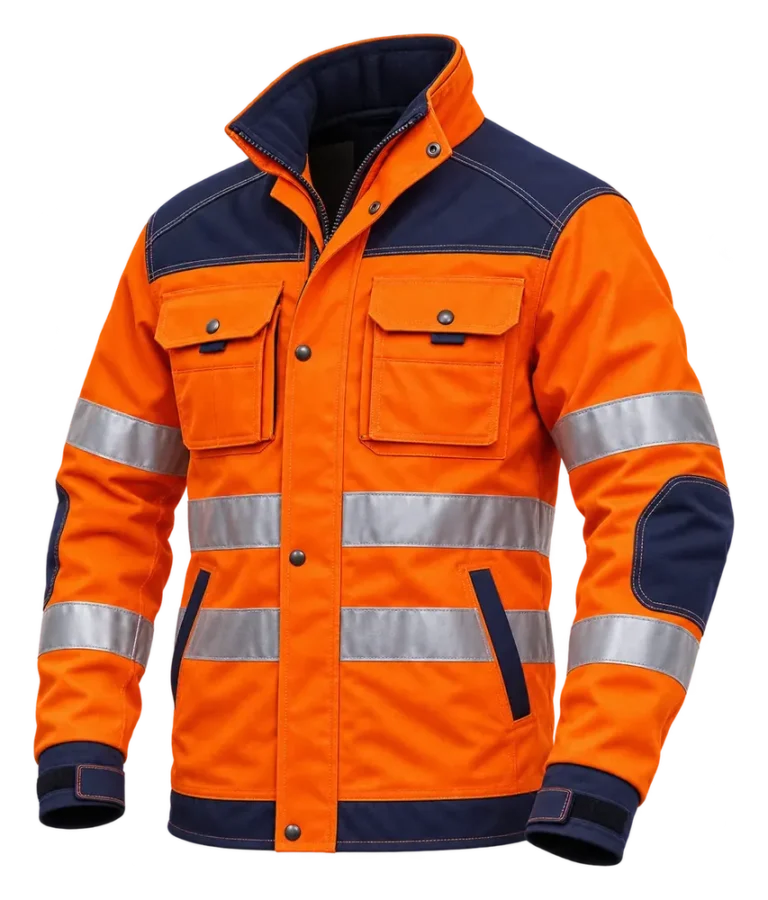
Reflective tape on custom work coveralls provides 360-degree night visibility when vehicle headlights illuminate working crews. Factories sew 50 mm (2-inch) wide reflective bands across key body landmarks so moving workers are recognised as human silhouettes. Placement includes vertical shoulder harness bands, a continuous mid-torso band, dual arm rings, and twin lower-calf rings.
Brands can specify 3M Scotchlite reflective material or alternative trims to buyer’s spec. Solid sew-on fabric tape offers high tear strength across commercial laundry cycles, whereas heat-applied segmented reflective tape flexes with the base cloth. All hi-vis reflective tape and base fabrics are sourced to buyer’s spec, with compliance documentation agreed directly between the brand and the mill.
How do factories draft action backs and sizing ease for workwear?
A work coverall requires significantly more dynamic pattern ease than casual outerwear because one-piece construction must accommodate bending, reaching and squatting without pulling. When bending forward at the waist, spine length expands by up to 100 mm; without pattern compensation, the garment pulls tight through groin and shoulders.
To solve this physical challenge, pattern makers incorporate an action-back (bi-swing) design into the rear shoulder yoke. Deep vertical pleats fold inwards behind each shoulder seam, secured internally with elastic stay tape. When a worker reaches forward to swing a tool or lift cartons, the pleats open up to provide 60 mm of dynamic ease across the upper back. Once arms return to rest, internal elastic pulls the pleats flat.
Waist construction balances neatness with functional flex. Tunnelled elastic along the rear waistband gathers excess cloth at the small of the back, while side elastic panels expand during squatting. In addition, our pattern room grades coveralls across regular, short and tall inseam lengths. Matching torso trunk length ensures knee pad pockets align directly over kneecaps rather than dragging down the shin.
What branding methods hold up under industrial laundering?
Branding on industrial workwear must withstand commercial laundry temperatures, chemical detergents, and constant sunlight without cracking, peeling or bleeding colour. Sialkot factories offer multiple branding techniques matched to your artwork and target laundry conditions.
Direct embroidery provides long service life for company names and trade emblems. Using 100 percent vat-dyed polyester thread prevents bleaching or fading when cleaned with chlorine disinfectants. Dense satin and tatami stitches embed firmly into twill without fraying.
Woven and twill patches offer clean lines for intricate corporate marks with small text. Manufactured with heat-sealed borders and stitched with perimeter lockstitches, patches can be replaced easily if an apparel rental fleet reassigns coveralls between contracts. For large back logos, screen printing with elastomeric polyurethane inks yields bright colour opacity while resisting wash cracking. Placement zones include left chest for name tapes, right chest for safety tags, upper back for company titles, and right sleeve for crests.
How does a coverall manufacturer manage sampling, MOQ and bulk production?
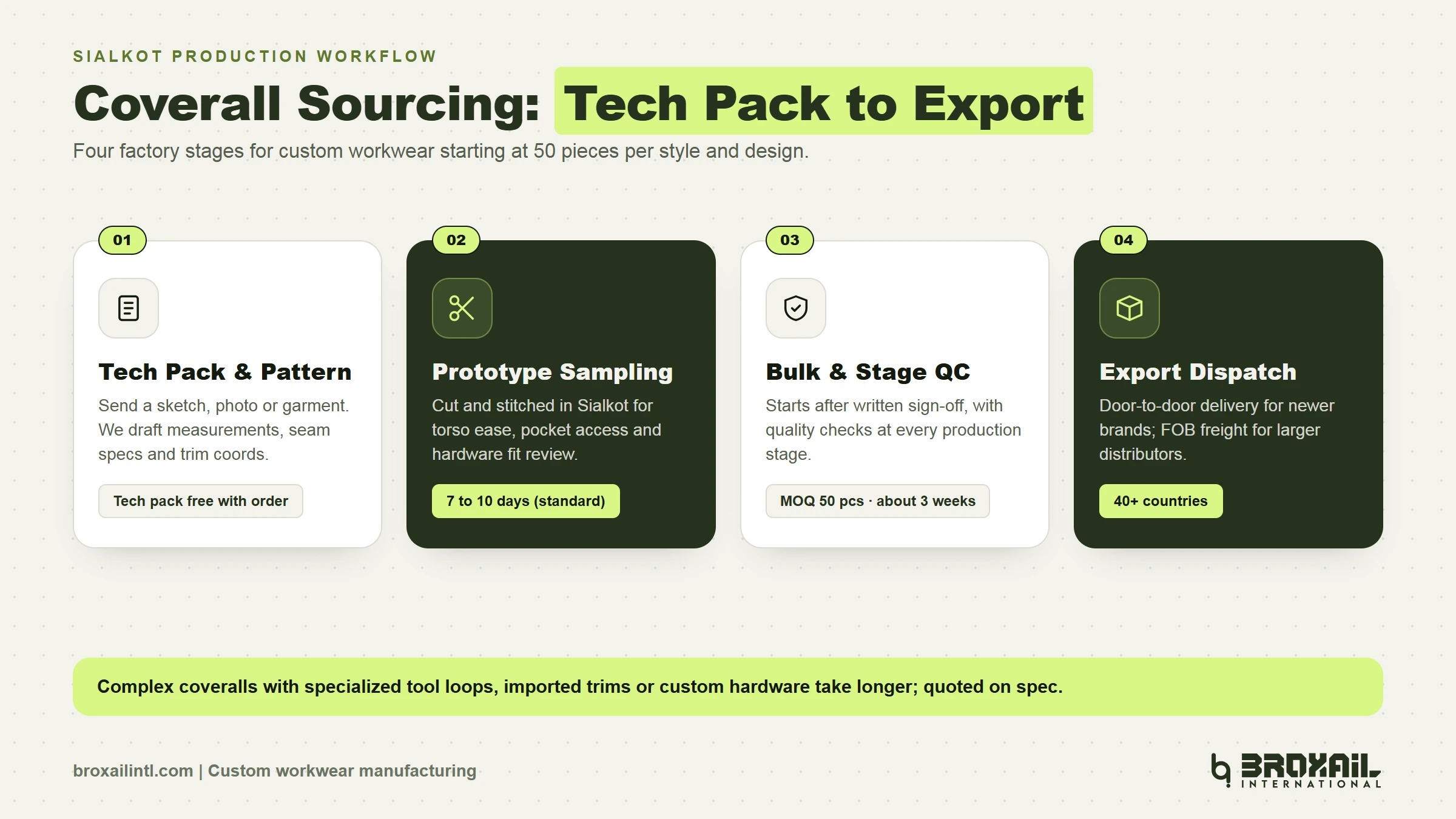
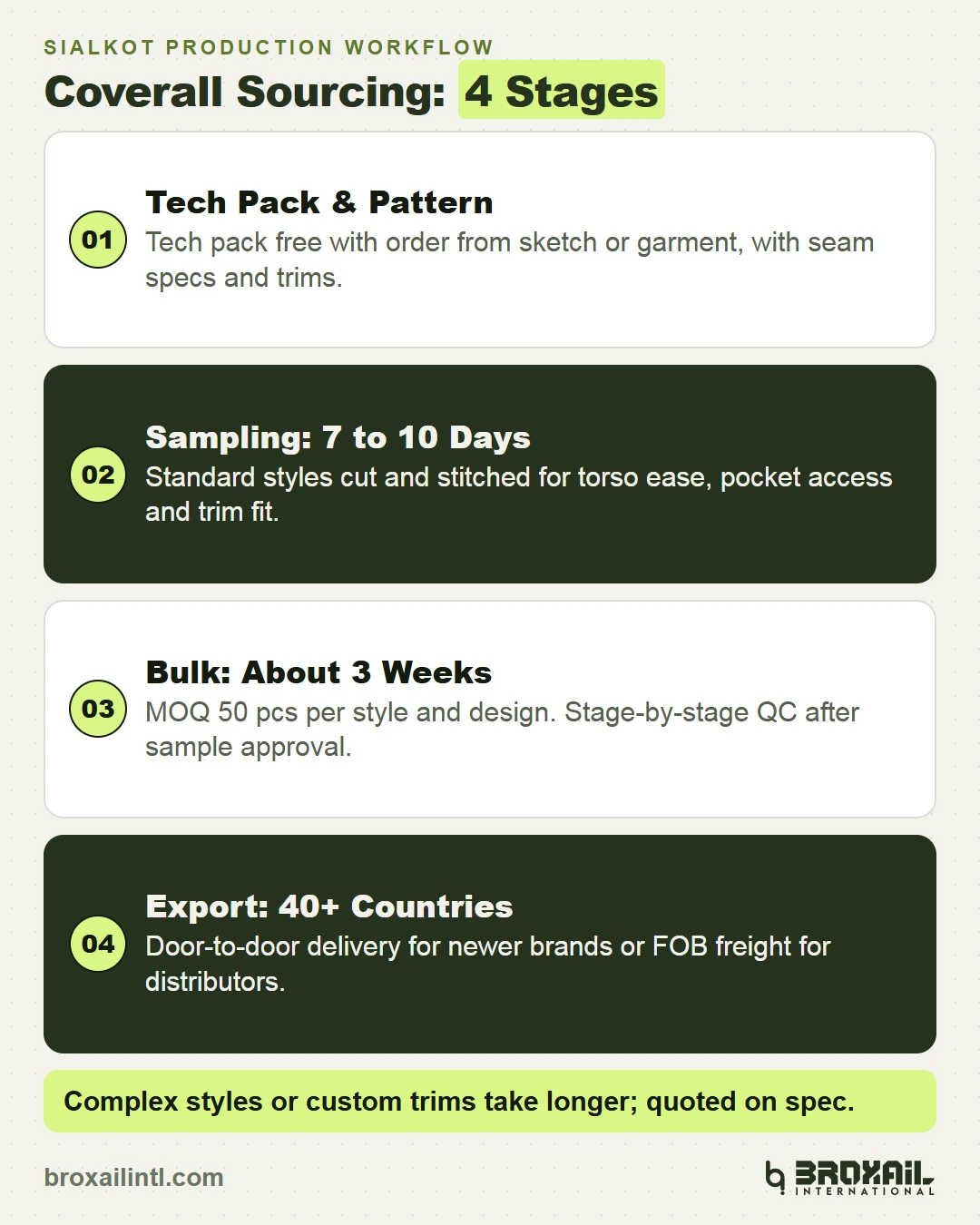
At BROXAIL International, private-label coverall manufacturing follows a clear four-step path in our Sialkot factory, as detailed on our clothing manufacturing process page and shown in our apparel manufacturing portfolio.
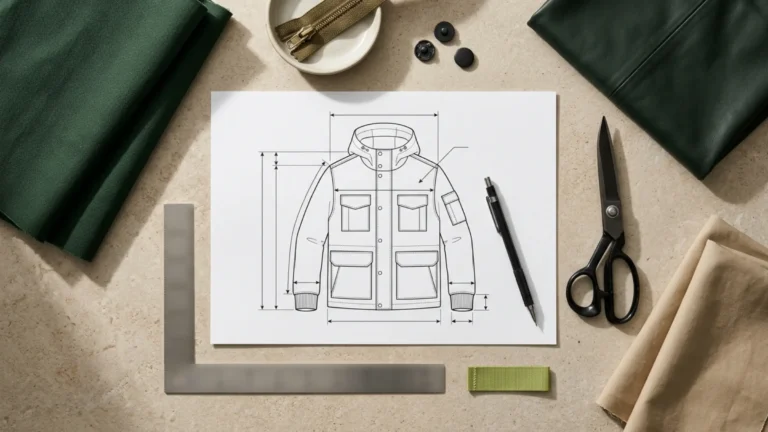
- Tech pack free with order and pattern drafting: Send reference photos, a rough sketch or a physical sample. BROXAIL includes a tech pack free with order, documenting measurements, seam tolerances, pocket coordinates and trim specs before cutting.
- Prototype sampling: Standard coverall styles take 7 to 10 days for a first sample. Complex garments with specialized tool loops, imported trims or custom hardware take longer depending on how complex the piece is.
- Bulk manufacturing and QC: Our minimum order quantity is 50 pieces per style and design across our workwear apparel range and all other lines. After sample approval in writing, bulk production takes about 3 weeks with quality checks at every stage.
- Export shipping: We export to 40+ countries. Newer brands usually choose door-to-door delivery to their address, while larger distributors book freight on FOB terms.
Frequently asked questions
What is the minimum order quantity for custom work coveralls?
BROXAIL International accepts a minimum order quantity of 50 pieces per style and design. You can split those 50 pieces across your required chest sizes and regular or tall leg lengths.
How long does a custom workwear coverall sample take?
Standard styles take 7 to 10 days. Complex utility coveralls with specialized tool attachments, imported trims or custom hardware take longer depending on the complexity of the piece.
How do you handle flame-resistant and hi-vis fabric certifications?
All shell fabrics, reflective tape and protective finishes are sourced to buyer’s spec. Mill certifications and test reports are agreed directly with each buyer according to target market standards.
Why do work coveralls feature an action-back shoulder pleat?
Action-back or bi-swing pleats give workers up to 60 mm of dynamic shoulder expansion when reaching forward. This prevents sleeves from riding up and relieves strain across back seams.
Can you ship custom workwear orders directly to our address?
We ship to 40+ countries using door-to-door delivery for newer brands and FOB freight terms for larger distributors who book their own transport.
Ready to build your workwear line?
Share your technical drawings, reference samples or uniform requirements with our Sialkot production team. We reply with material options, lead time estimates, and a tech pack free with order. Request a quote today.

Written by
Muhammad Abubakar
Muhammad Abubakar runs BROXAIL International, a custom leather and textile apparel manufacturer in Sialkot, Pakistan. He works with brands, labels and wholesalers from the first sample to delivery.