CE Level 1 vs CE Level 2 Armour: Guide for Motorcycle Jacket Brands
CE Level 1 vs Level 2 armour for motorcycle jackets: EN 1621 force limits, EN 17092 garment classes and how armour pockets are built.
Key takeaways
- CE Level 2 armour transmits roughly half the peak impact force (≤ 20 kN for limbs, ≤ 9 kN for back) of Level 1 pads.
- European standard EN 1621 certifies impact armour independently from EN 17092 garment abrasion and tear ratings.
- Back protectors are not legally required to certify an EN 17092 garment, but riders expect dedicated pockets.
- Engineered pocket placement with pre-curved sleeve ergonomics prevents protectors from shifting during a slide.
- Sialkot OEM manufacturing offers built-in armour pockets with low 50-piece MOQs and 7 to 10 day sampling.
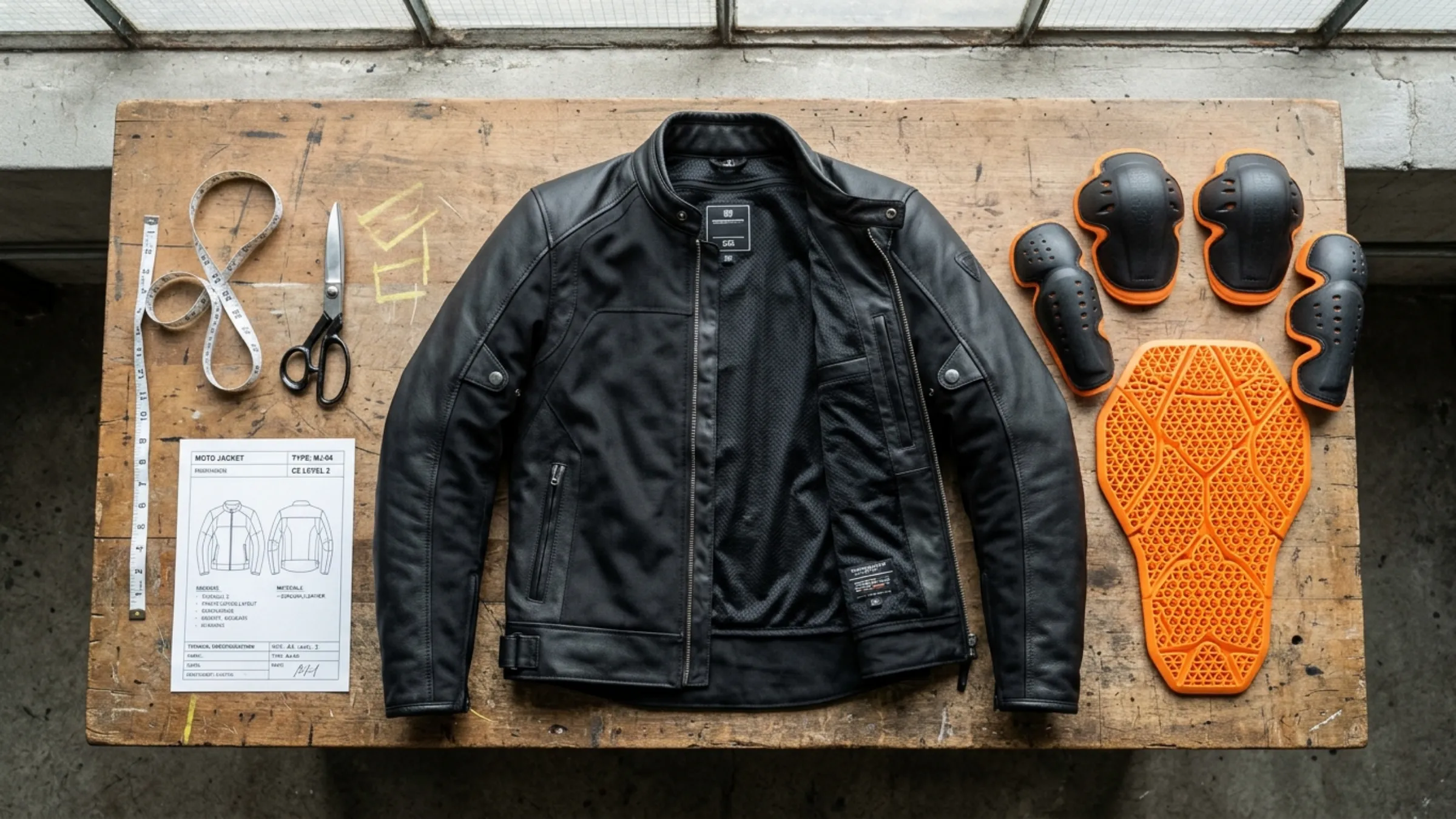
Choosing between Level 1 and CE level 2 armour is a key product decision when developing private label motorcycle jackets. Independent apparel brands, sourcing managers, and startups must balance rider safety, impact test thresholds, garment weight, bulk, and retail margins.
Under European personal protective equipment (PPE) rules, motorcycle impact protectors fall under the EN 1621 standards series. In simple terms, CE level 2 armour transmits roughly half the peak impact force of Level 1 pads to the rider’s body during a crash. While Level 1 suits lightweight commuter gear, Level 2 has become the expected benchmark for touring, adventure, and performance riding collections.
This technical guide explains how European impact standards work, breaks down transmitted force limits, clarifies garment classification under EN 17092, and shares practical factory insights on engineering armour pockets for production.
European armour standards explained
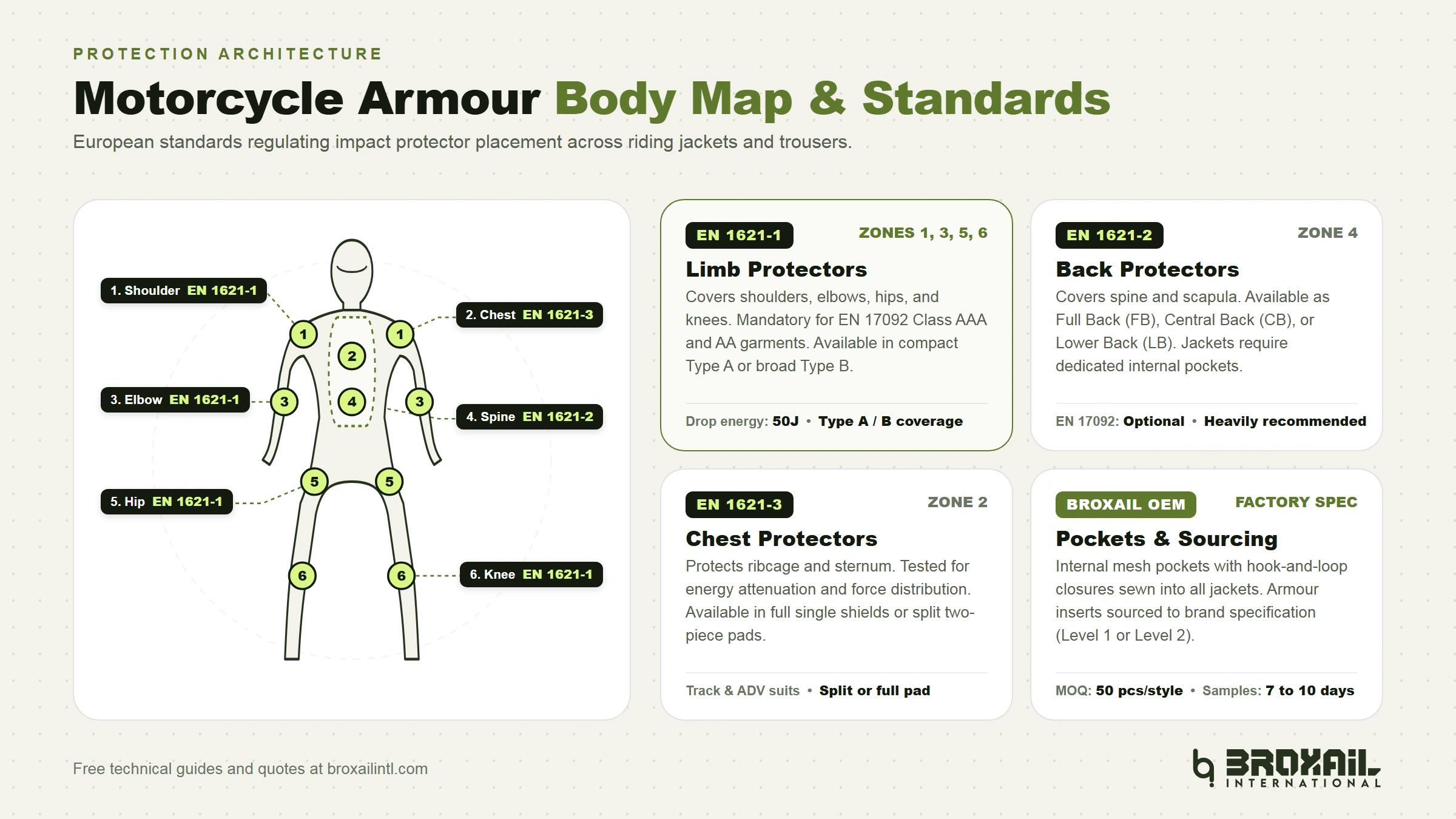
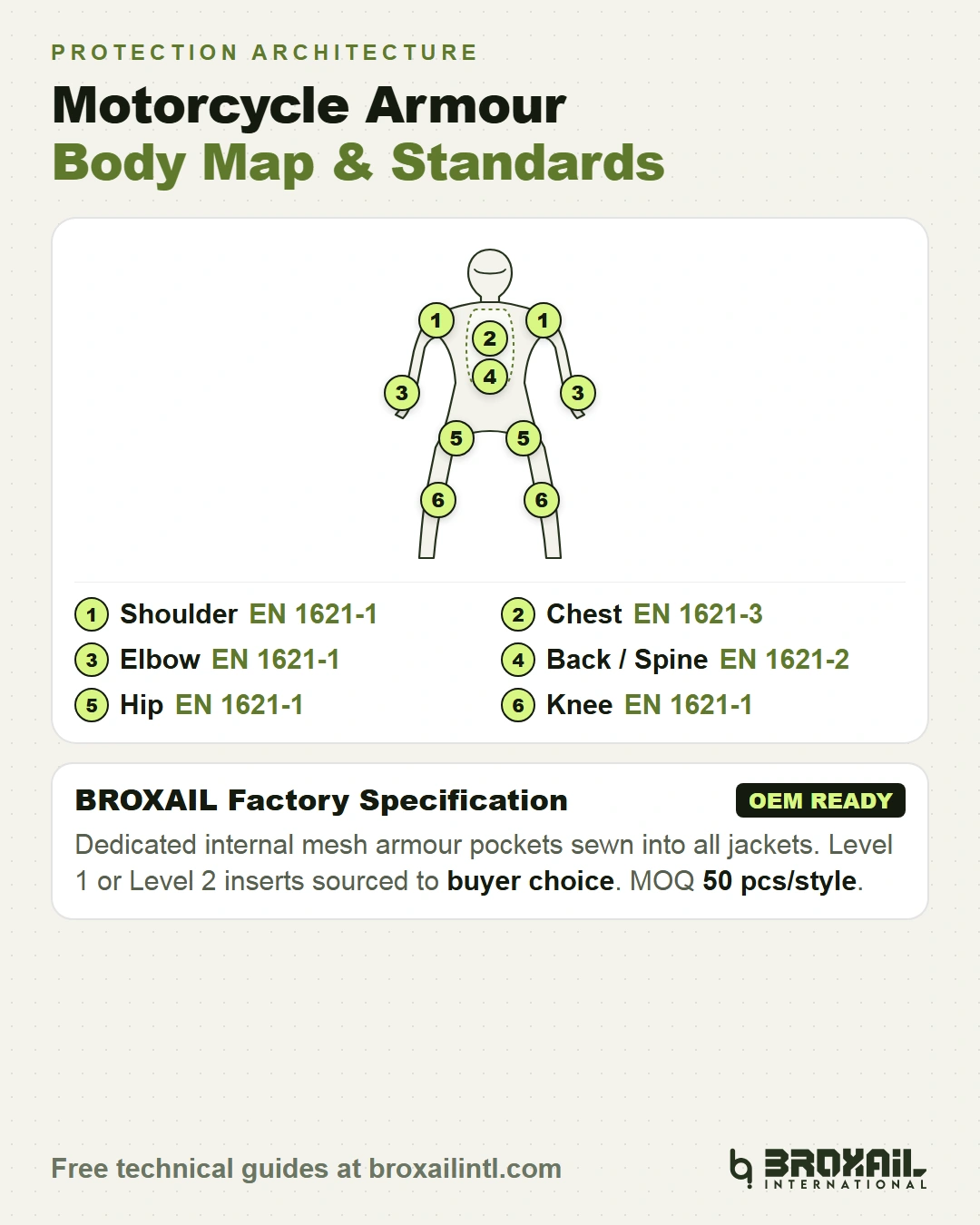
Motorcycle body armour is tested and certified independently from the outer garment shell. Three harmonised European standards regulate impact protectors by body placement:
- EN 1621-1 (Limb Protectors): Shoulders, elbows, hips, knees, and shins.
- EN 1621-2 (Back Protectors): Central back, lower back, and full spine protectors.
- EN 1621-3 (Chest Protectors): Divided and full chest impact shields.
During certification testing, an impactor drops a 50 Joule kinetic strike (a 2.5 kg weight dropped from two metres) onto the protector resting on a steel anvil. Load cells beneath the anvil measure the transmitted force in kilonewtons (kN). Lower kilonewton numbers indicate better shock absorption.
EN 1621-1: Limb Protectors (Shoulders and Elbows)
Limb protectors undergo nine strikes across ambient, high-temperature (+40°C), and low-temperature (-10°C) conditions:
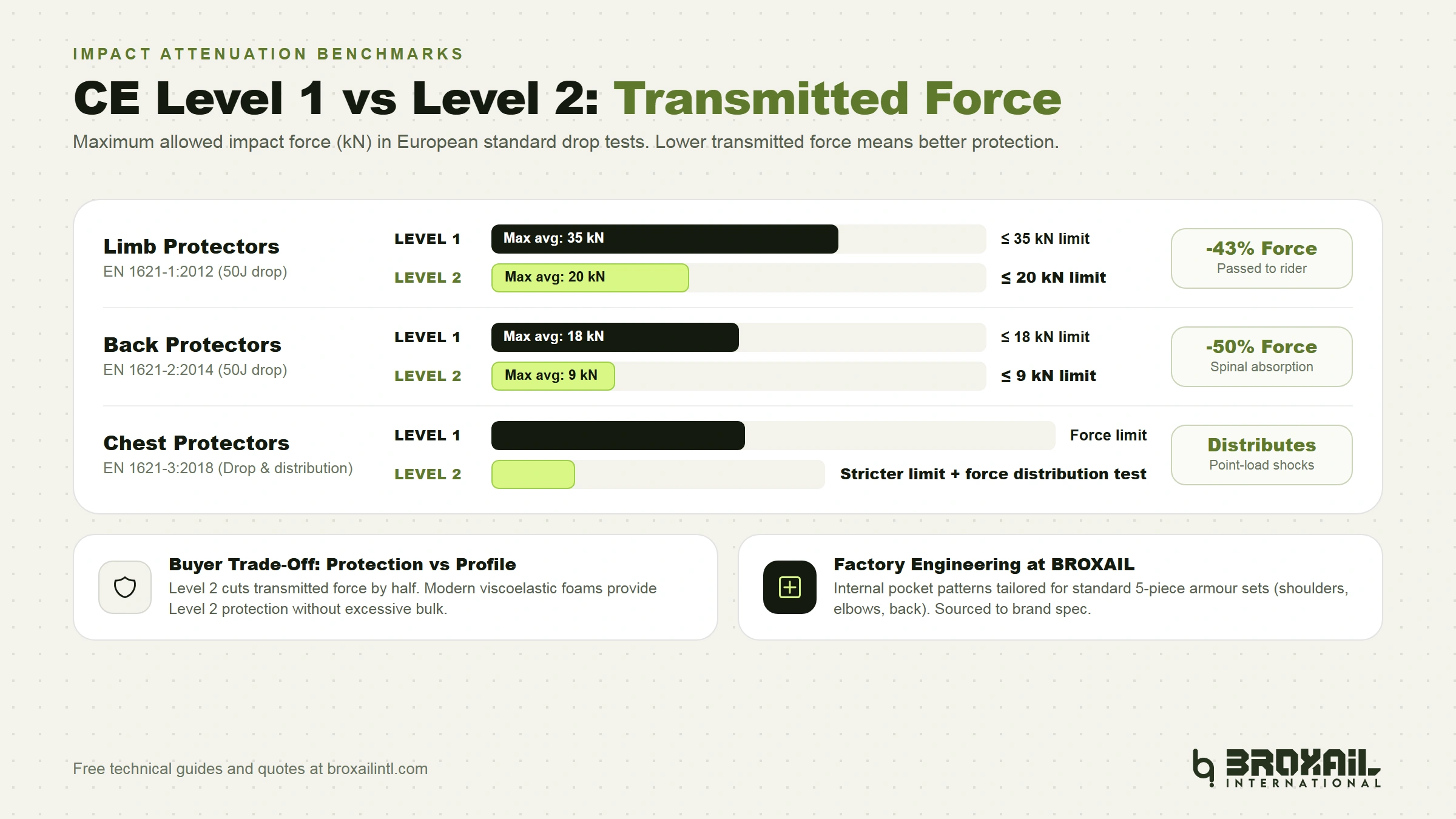
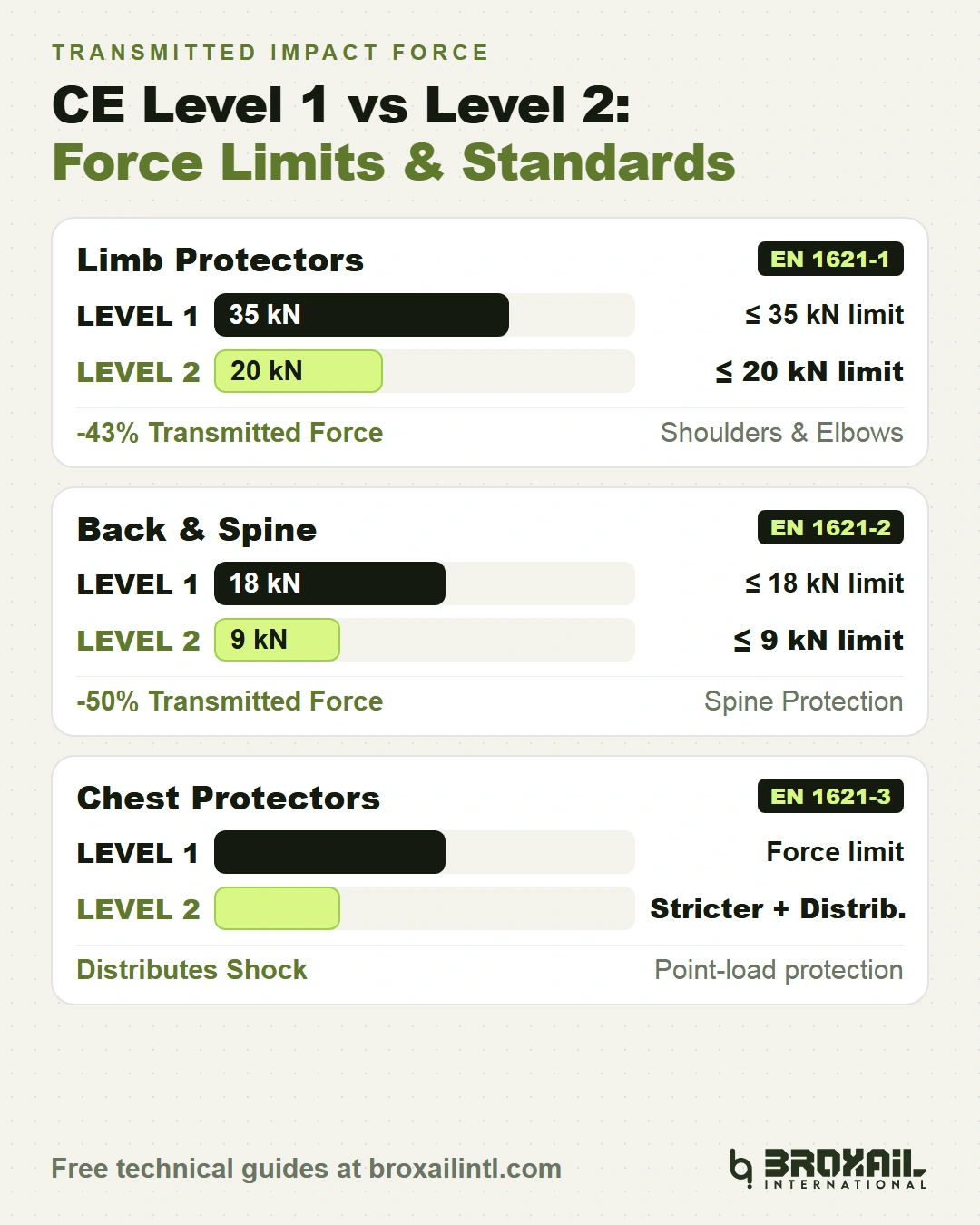
- Level 1: Average transmitted force must not exceed 35 kN, with no single strike above 50 kN.
- Level 2: Average transmitted force must not exceed 20 kN, with no single strike above 35 kN.
Level 2 limits transmitted force to 20 kN, delivering 43% greater shock absorption than Level 1.
EN 1621-2: Back Protectors (Spine Protection)
Because the human spine is exceptionally vulnerable to blunt trauma, EN 1621-2 enforces stricter limits:
- Level 1: Average transmitted force must not exceed 18 kN, with no single strike above 24 kN.
- Level 2: Average transmitted force must not exceed 9 kN, with no single strike above 12 kN.
A Level 2 back protector cuts transmitted force by half compared to Level 1. Back protectors come in three shapes: Full Back (FB), Central Back (CB), and Lower Back (LB). Higher-end motorcycle jackets typically use Full Back (FB) pocket sizing.
EN 1621-3: Chest Protectors
Specified primarily for adventure touring and track garments:
- Level 1: the protector must meet the force transmission limit set in the standard.
- Level 2: it must meet a stricter limit and an extra force distribution test, so the impact is spread over a wider area of the chest (SATRA summary of EN 1621). Ask your armour supplier for the test report with the exact values.
CE Level 2 armour vs Level 1: force limits
The following comparison illustrates how impact force thresholds differ between levels across European testing protocols:
| Protection Zone | Harmonised Standard | Level 1 Max Average Force | Level 2 Max Average Force | Impact Reduction Difference |
|---|---|---|---|---|
| Shoulders & Elbows | EN 1621-1 | ≤ 35 kN | ≤ 20 kN | 43% less force transmitted |
| Spine & Back | EN 1621-2 | ≤ 18 kN | ≤ 9 kN | 50% less force transmitted |
| Chest Protectors | EN 1621-3 | Force limit (see test report) | Stricter limit + force distribution test | Enhanced load dispersion |
Armour materials: foam vs viscoelastic
Historically, motorcycle armour used hard plastic shells over rigid EVA foam. While protective, traditional armour was stiff and created bulky silhouettes.
Today, motorcycle brands predominantly use flexible viscoelastic polymers and polyurethane elastomers (such as D3O, SAS-TEC, or custom PU memory foams). These materials stay soft and pliable against the body during normal riding.
On sudden impact, the molecules lock instantly to absorb and disperse shock before returning to their flexible state. This allows Level 2 protection in slim-fit leather or textile jackets without excess bulk. Compare classic silhouettes in our guide to types of jackets.
Armour and EN 17092 garment classes
Brand owners frequently confuse garment certification with armour certification. EN 1621 certifies the individual protective pad, while the EN 17092 motorcycle garment standard certifies the entire completed garment as protective riding wear.
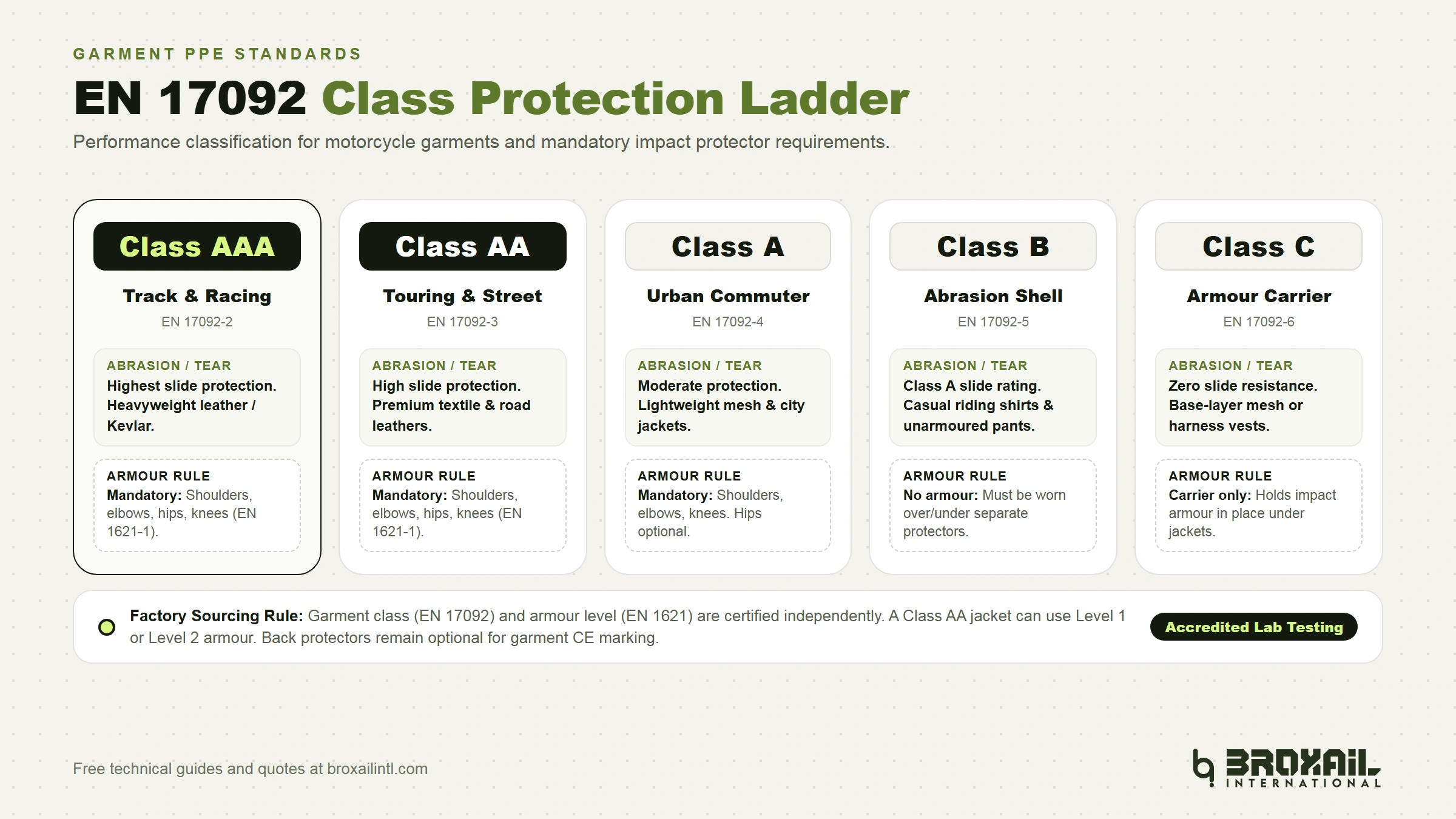
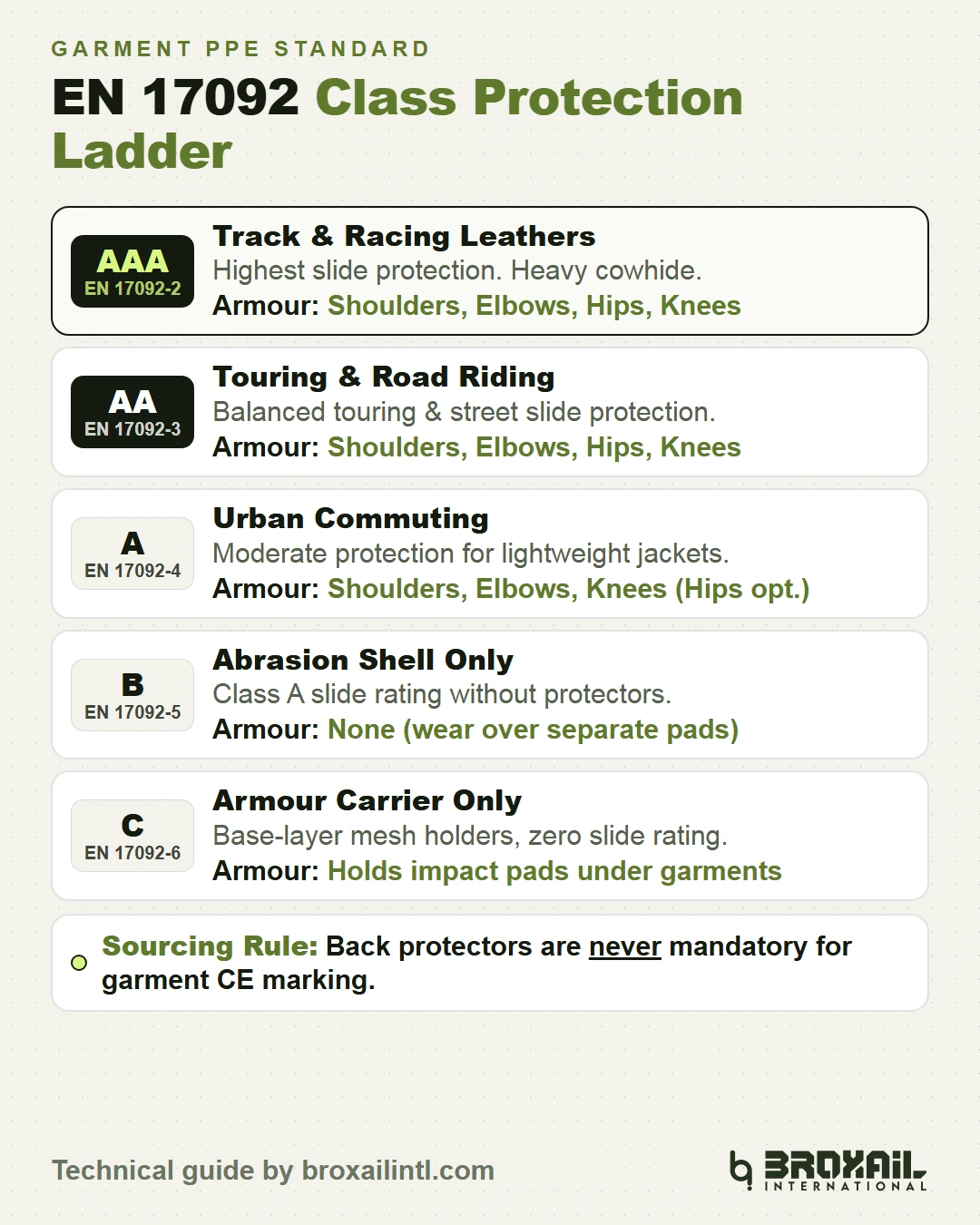
EN 17092 establishes five protective garment classes based on structural tear resistance, seam strength, dimensional stability, and abrasion resistance across designated impact zones (Zones 1, 2, and 3):
- Class AAA (Heavy Duty): Highest abrasion and tear resistance for track and sport riding (heavy cowhide or kangaroo leather). Requires shoulder, elbow, hip, and knee protectors.
- Class AA (Touring & Street): Industry benchmark for touring and highway riding. Balances heavy abrasion resistance with daily comfort. Requires shoulder, elbow, hip, and knee protectors.
- Class A (Urban Commuting): Designed for city riding and warm weather. Allows lighter textiles or fashion leather shells. Requires shoulder, elbow, and knee protectors (hip armour optional).
- Class B (Abrasion Only): Meets Class A abrasion criteria without armour. Intended to be worn over separate modular armour shirts.
- Class C (Impact Carrier Only): Mesh undergarments holding armour in position against the body, with no abrasion shell.
The Back Protector Paradox in EN 17092
A common surprise for new apparel brands is that back protectors are not mandatory to achieve Class AAA, AA, or A garment certification under EN 17092. The standard mandates impact pads only on limb joints.
However, offering a motorcycle jacket without a back protector pocket severely hurts retail appeal. Knowledgeable riders expect an internal back pocket sized for a CE Level 2 central back or full back insert. Brands usually sell jackets with an internal pocket containing a removable low-density transport foam pad, offering certified Level 2 back inserts as an optional add-on or including them as a standard feature.
How armour pockets are built
An impact protector is only effective if it remains positioned over the rider’s joint during a slide. Poorly constructed pockets allow armour to twist, shift, or drop below the elbow or shoulder bone upon impact.
When manufacturing private label jackets at our factory in Sialkot, we apply strict construction standards:
1. Armour Pocket Fabrics
We line internal armour pockets with breathable 180 GSM polyester micro-mesh or soft stretch lycra. Mesh facilitates heat and sweat dissipation from the rider’s body, preventing viscoelastic foams from hardening or feeling clammy on long journeys.
2. Dual-Height Adjustable Elbow Pockets
Riders have differing forearm lengths. A fixed elbow pocket frequently causes the armour pad to sit too low, leaving the vulnerable elbow bone exposed. We incorporate internal hook-and-loop positioning ladders inside elbow pockets, allowing riders to adjust the pad up or down by 25 mm to 40 mm for a custom anatomical fit.
3. Reinforced Seams and Closure Flaps
Armour pockets must withstand centrifugal pulling forces during a slide. We stitch pocket edges directly into internal chassis seams using twin-needle thread locks. Pocket entries feature secure hook-and-loop flap closures or envelope folds that prevent heavy protectors from slipping out while riding.
To learn more about hide selections that work best with protective motorcycle gear, review our guide to types of leather for jackets and our capabilities as an experienced leather jacket manufacturer.
CE labels and test documents
To sell motorcycle riding garments in the UK and EU, products must comply with PPE Regulation (EU) 2016/425 and UKCA rules. Production garments require:
- Stitched CE Garment Label: Displays the motorcycle pictogram, EN 17092 standard, certified class (e.g. Class AA), size, and care symbols.
- Component CE Stamps: Each armour pad must bear its own CE stamp displaying EN 1621-1, EN 1621-2, or EN 1621-3, along with Level 1 or Level 2 and temperature marks (T+, T-).
- User Information Booklet: A printed booklet explaining protection limits, fit adjustments, and care instructions must accompany each garment.
- EU Declaration of Conformity (DoC): Brands must maintain an accessible digital Declaration of Conformity online.
Always verify that supplier test reports originate from accredited notified bodies (such as SATRA, Ricotest, or IDIADA).
How BROXAIL makes motorcycle gear
BROXAIL International manufactures custom leather and technical textile motorcycle jackets for independent apparel brands, riding clubs, and gear distributors from our factory in Sialkot, Pakistan:
- Custom Armour Integration: We build internal armour pockets to your exact CAD specs, using your supplied armour or certified Level 1 and Level 2 inserts sourced to your requirements.
- Flexible 50-Piece MOQ: Our minimum order quantity is 50 pieces per style and design, allowing startups to produce focused collections without excess inventory risk.
- Fast Sampling: Pre-production fit samples take 7 to 10 days for standard styles. (Complex styles or custom trims take longer).
- Free Tech Pack Support: Every production run includes complete pattern drafting and digital tech packs by our technical tailoring team.
- Global Shipping: We ship to brand warehouses in over 40 countries, offering door-to-door courier delivery for emerging labels or direct FOB freight booking.
- Accredited Lab Testing: Garment testing for EN 17092 compliance is conducted through accredited third-party test houses on client request.
Review our full range of riding outerwear across our motorbike jackets range or speak with our team to request a quote for your upcoming collection.
Frequently asked questions
What is the primary difference between CE Level 1 and CE Level 2 armour?
CE Level 2 armour transmits roughly half the peak impact force of Level 1 armour to the body. Under EN 1621-1 limb tests, Level 2 limits average transmitted force to 20 kN compared to 35 kN for Level 1. Under EN 1621-2 back protector tests, Level 2 permits only 9 kN of average force compared to 18 kN for Level 1.
Are back protectors legally mandatory in CE-approved motorcycle jackets?
No. Under the EN 17092 garment standard, back protectors are optional even for the highest Class AAA garments. However, knowledgeable riders expect a back protector pocket. Most brands engineer internal pockets that fit removable CE Level 2 back pads to meet consumer expectations.
Can we supply our own branded CE armour for BROXAIL to insert into jackets?
Yes. You can supply your own branded protectors (such as custom-branded D3O, SAS-TEC, or custom PU pads) directly to our factory, or our sourcing team can procure certified CE protectors that match your technical specifications.
How do you prevent armour pads from shifting out of position while riding?
We engineer custom internal pockets with tailored envelope openings, secure hook-and-loop closures, and internal vertical adjustment ladders on elbow pockets. This ensures protectors remain seated directly over joints regardless of arm length.
What is the minimum order quantity for custom motorcycle jackets with armour pockets?
Our minimum order quantity is 50 pieces per style and design. You can split this quantity across standard sizing from XS to 5XL. Bulk production typically takes about three weeks following physical sample sign-off.
Start your armoured jacket range
Ready to develop a compliant, high-performance motorcycle jacket line for your brand? Contact our engineering team in Sialkot to review your sketches, refine your pocket patterns, and request a quote.

Written by
Muhammad Abubakar
Muhammad Abubakar runs BROXAIL International, a custom leather and textile apparel manufacturer in Sialkot, Pakistan. He works with brands, labels and wholesalers from the first sample to delivery.