Leather Jacket Manufacturer for Small Brands: How to Start
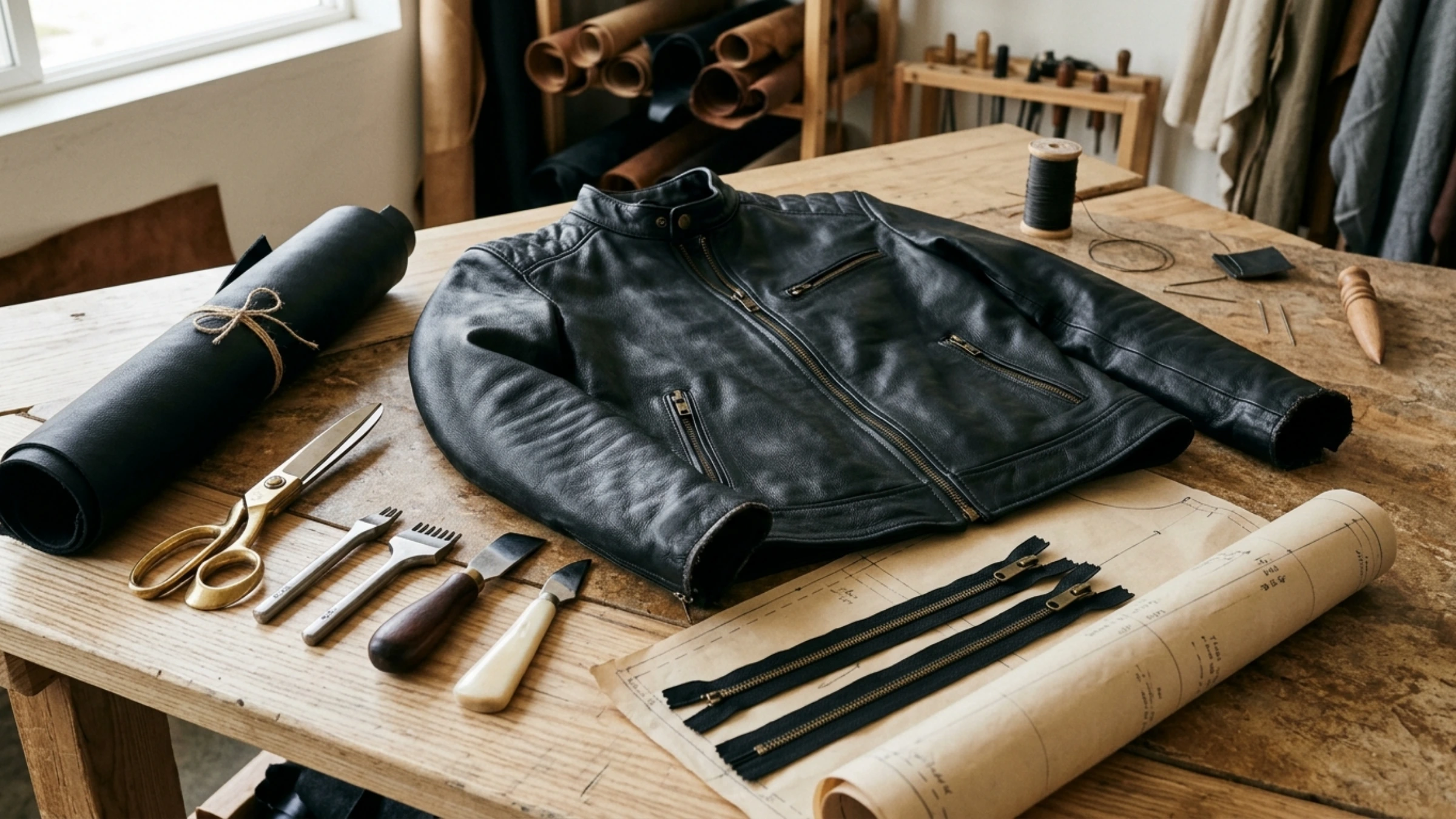
Finding a reliable leather jacket manufacturer for small brands is often the hardest step when launching an independent outerwear label. Large heritage tanneries and high-volume garment plants frequently demand minimum orders of 300 to 500 pieces per style, locking out emerging founders before their first collection ever reaches a sample rail.
Working directly with an export-focused factory in Sialkot, Pakistan solves that bottleneck. At BROXAIL International, our minimum order quantity (MOQ) is 50 pieces per style and design, split across your chosen size run. We include a tech pack free with order, produce standard samples in 7 to 10 days, and complete bulk production in about 3 weeks after you approve your pre-production sample.
Key takeaways
- Low-MOQ Entry: Produce custom private-label leather jackets at 50 pieces per style and design, mixed across sizes (for example, S, M, L, and XL).
- Tech Pack Free With Order: Send reference photos, sketches, or an existing garment, and our pattern team prepares a production tech pack with your order.
- Fast, Predictable Lead Times: Standard leather jacket samples take 7 to 10 days, followed by about 3 weeks for bulk manufacturing after sample sign-off.
- Specification to Buyer’s Spec: Choose hide type (sheep, cow, goat, or buffalo), tannage, grain grade, lining, and branded hardware such as YKK zips to match your target retail tier.
Why Choosing the Right Leather Jacket Manufacturer for Small Brands Matters
Leather garment production requires specialised machinery and pattern skills that general cut-and-sew textile workshops do not possess. Unlike woven cotton or polyester rolls with uniform width and zero surface flaws, every natural hide has a unique contour, spine line, and thickness profile from shoulder to belly.
When a small brand works with a trading company or middleman instead of a direct custom leather jacket manufacturer, two problems usually occur. First, your margin is eaten by broker markups at low quantities. Second, technical notes about grain matching, skiving thickness at seams, and zipper tape tension get lost between the agent and the cutting floor.
Direct factory communication lets founders control hide selection, pattern grading, and trim placement from day one. Whether you are launching a classic lambskin café racer, a heavy cowhide biker jacket, or a minimal shearling-collar flight bomber, working straight with the production line keeps quality consistent from the first prototype to repeat orders.
How the 50-Piece MOQ Works Across Sizes
Many startup founders assume a 50-piece minimum means ordering 50 identical jackets in a single size. In practice, our 50-piece MOQ applies per style and design, and you can distribute those 50 units across multiple sizes on the same pattern block.
For example, a balanced first drop for a men’s or unisex leather jacket often follows a classic bell curve across five sizes:
- Size XS: 5 pieces
- Size S: 10 pieces
- Size M: 15 pieces
- Size L: 12 pieces
- Size XL: 8 pieces
- Total: 50 pieces (one style, one colourway)
Keeping your first production run to one core silhouette and one hide colour maximises cutting yield per square foot of leather and keeps your initial inventory commitment manageable. Once that core style sells through, reordering or adding a second colourway on the approved pattern block is straightforward because the grading rules are already locked.
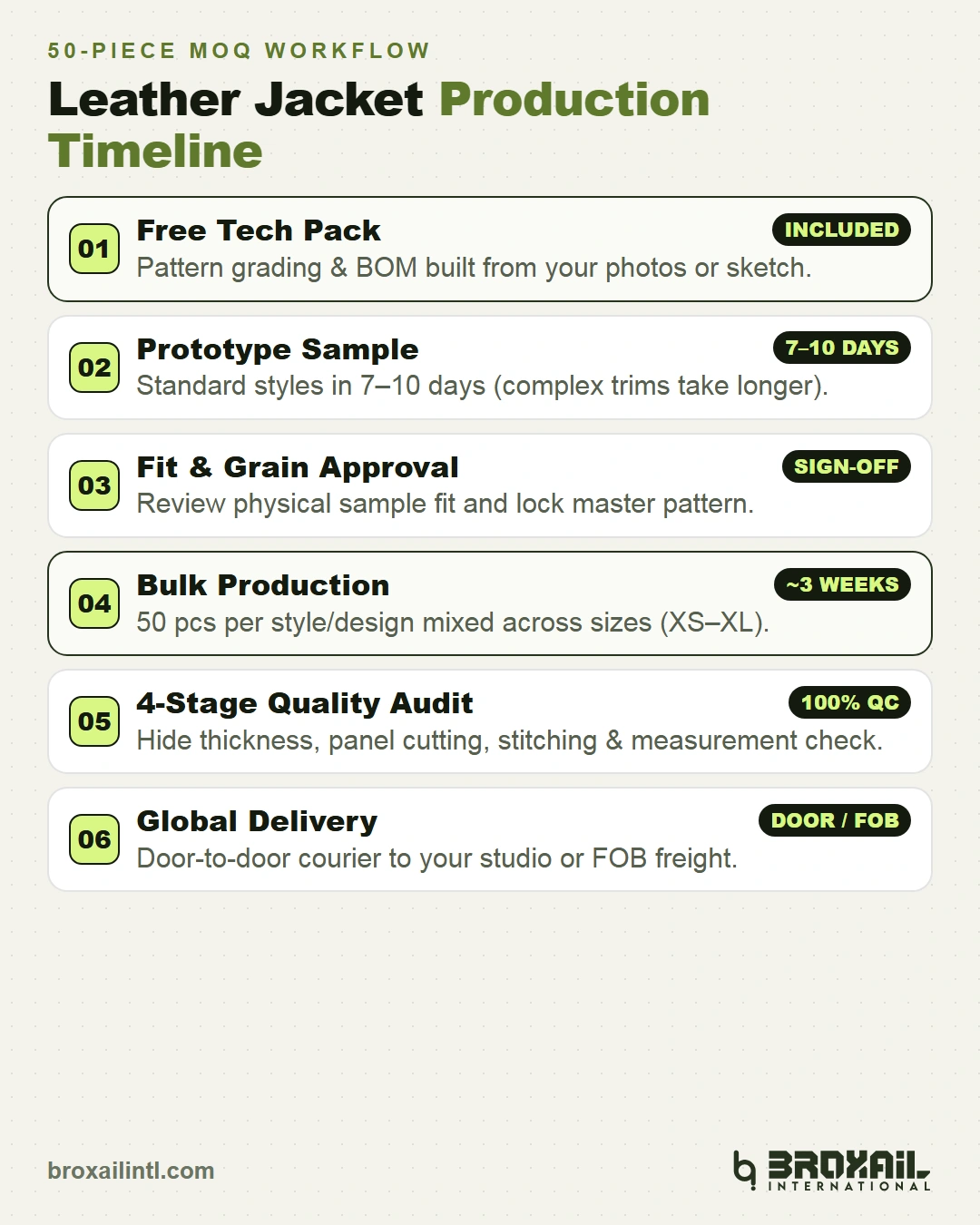
Step-by-Step Timeline: From Idea to Bulk Delivery
Small brands do not need an in-house technical designer to begin sampling. Our engineering team turns rough concepts into factory-ready specifications before cutting a single hide.
1. Tech Pack Free With Order and Pattern Engineering
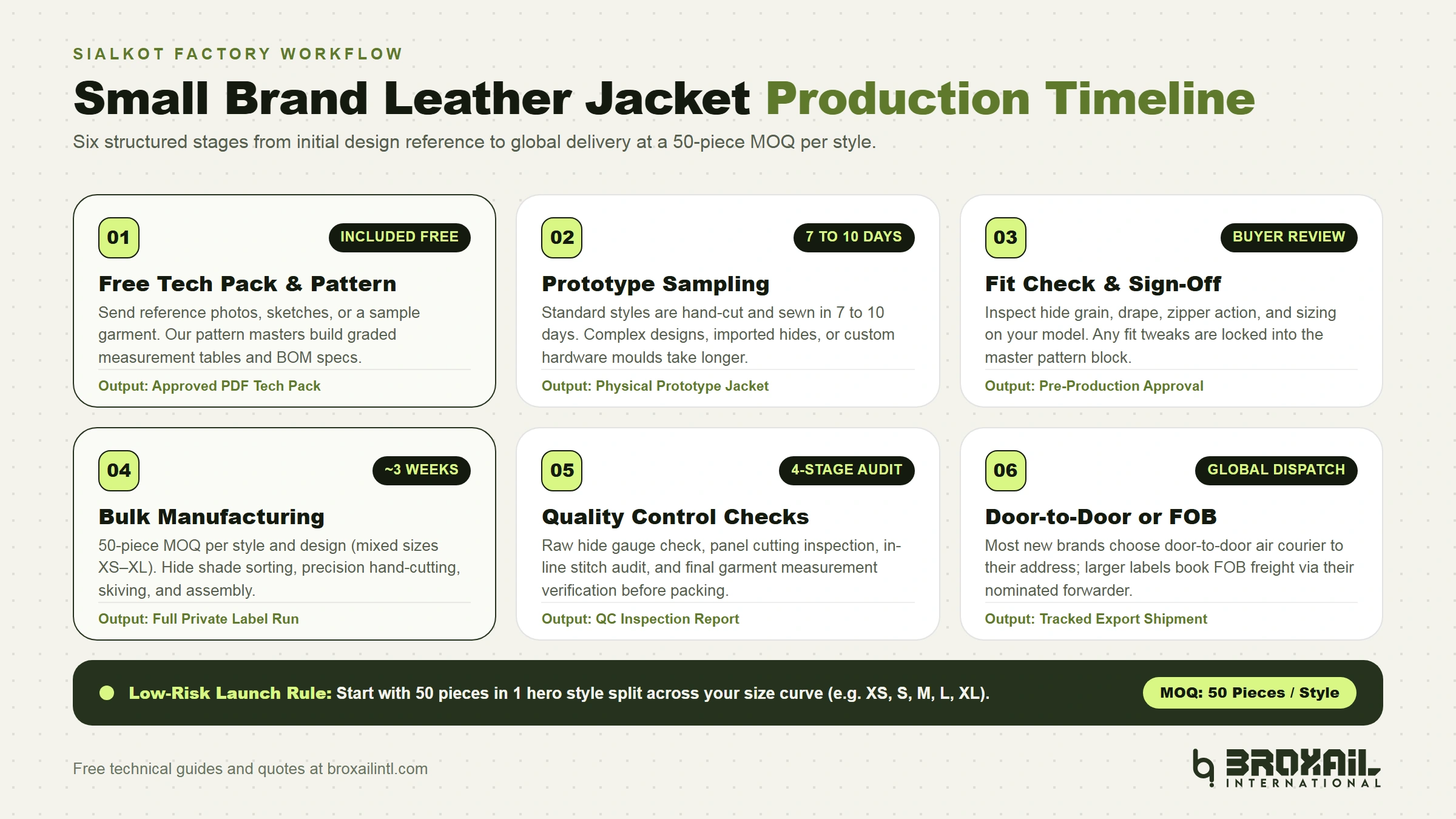
You share reference photographs, flat sketches, target measurements, or a physical sample jacket. Our pattern masters draft a complete tech pack free with order covering graded measurement tables, seam construction diagrams, stitch density, lining specs, and trim callouts. You review and approve this PDF before sampling starts.
2. Prototype Sampling (7 to 10 Days for Standard Styles)
Once the tech pack is confirmed, our sample room hand-cuts and builds your prototype using your specified leather hide, lining, and hardware. Standard styles take 7 to 10 days to complete.
If your design requires complex panelling, imported hides, custom-dyed leather batches, or custom-moulded zipper pulls and snaps, sampling takes longer depending on the complexity of the piece. Rather than rushing a complex garment, we confirm the exact schedule once we review your trim list.
3. Fit Review and Sample Approval
We ship the physical sample to your studio (accompanied by detailed multi-angle photos and measurement verification videos before dispatch). You test the fit on a model, inspect the grain hand-feel, and note any adjustments to sleeve length, chest ease, or pocket placement before signing off for bulk production.
4. Bulk Production (About 3 Weeks)
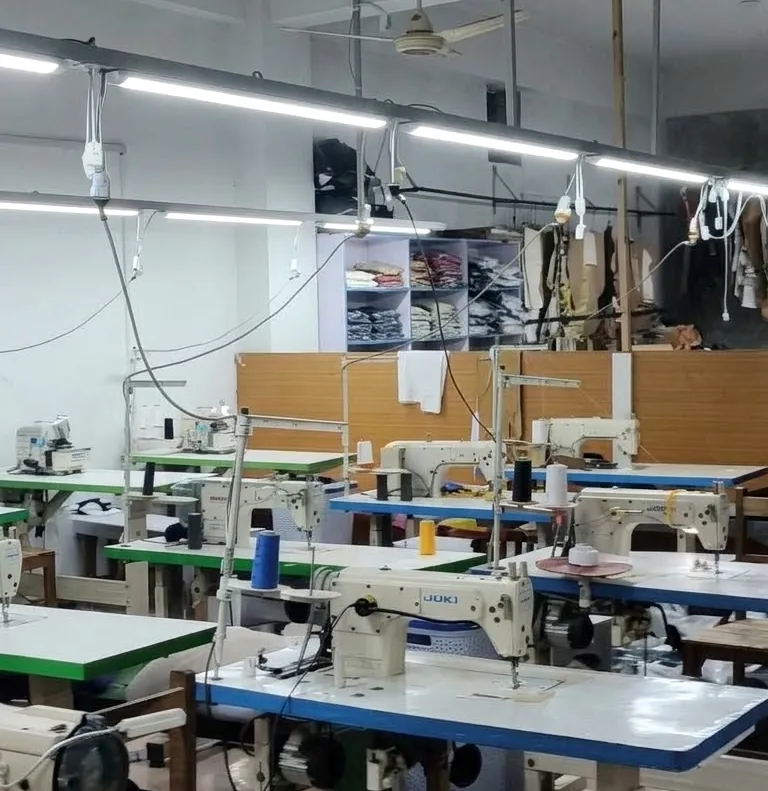
After you approve the final sample, bulk manufacturing takes about 3 weeks. During this window, hides are sorted for shade and thickness consistency, panels are cut by hand to avoid natural scars, edges are skived for flat seams, and garments move through dedicated leather sewing, pressing, and finishing stations.
5. Four-Stage Quality Control
Every batch undergoes four structured inspections before packing:
- Raw Hide Inspection: Checking skin thickness (measured in millimetres with a gauge), surface grain uniformity, and colour fastness.
- Panel Cutting Audit: Verifying that belly leather is never placed on high-stress outer panels like shoulders or elbows.
- In-Line Sewing Check: Checking stitch tension, needle size, seam symmetry, and zipper alignment while jackets are on the line.
- Final Measurement & Finishing Check: Measuring finished garments against the approved tech pack tolerance chart, testing every snap and zipper, and conditioning the leather before polybagging.
What Drives the Unit Cost of a Custom Leather Jacket?
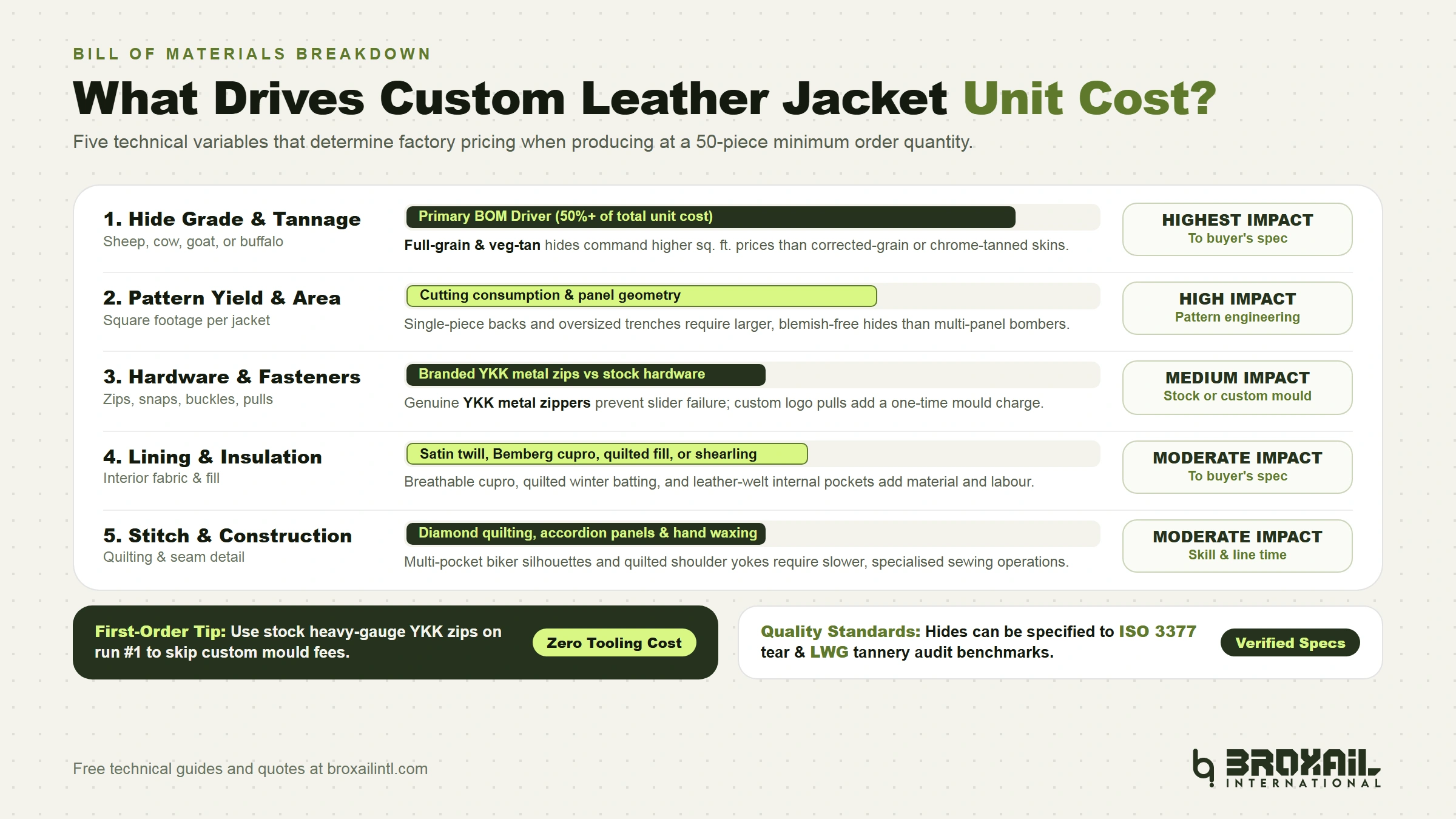
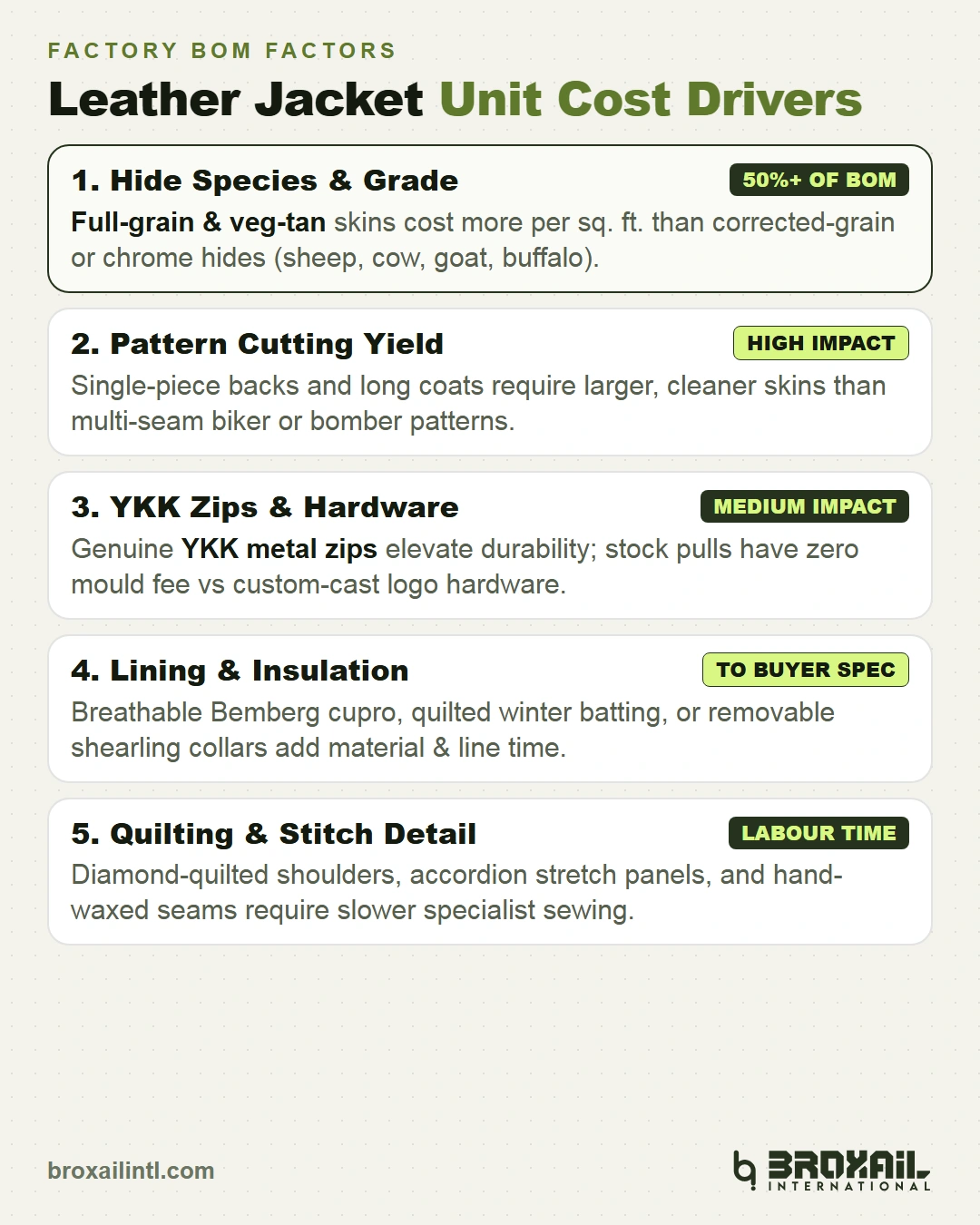
Instead of publishing flat catalogue prices that ignore material grades, a transparent factory prices each project from its bill of materials (BOM). Because leather hides are traded by area (square feet) and graded by surface perfection, five core variables determine your unit cost.
1. Hide Species, Grain Grade, and Tannage
The leather skin itself accounts for more than half of the total cost of a jacket. All hide specifications are sourced to buyer’s spec, allowing you to match your brand positioning:
- Animal Species: Supple sheepskin (lambskin) is prized for fashion jackets; cowhide and buffalo hide offer thicker, high-abrasion protection for biker and workwear silhouettes; goatskin delivers a pebbled grain with high tensile strength at medium weight. Read our guide on types of leather for jackets for a full breakdown.
- Grain Grade: Full-grain and top-grain hides retain the dense outer dermis fibres and command higher prices per square foot than corrected-grain or split suede leathers. If you are comparing real hides against synthetic alternatives, see our comparison of PU leather vs genuine leather.
- Tanning Method: Chrome-tanned leather offers consistent colour, water resistance, and fast turnaround; vegetable-tanned leather uses natural bark tannins for heritage patina development and costs more in raw skin procurement.
When specifying performance and durability requirements on your tech pack, buyers can reference internationally recognised laboratory test methods such as ISO 3377 for leather tear load determination and ISO 11640 for colour fastness to rubbing. Brands with strict sustainability reporting can also request hides sourced from tanneries audited under Leather Working Group (LWG) environmental standards.
2. Pattern Yield and Panel Geometry
Large, uninterrupted back and front panels require cleaner, higher-grade skins because the cutter cannot work around natural hide markings. A jacket with a single-piece back panel consumes more square footage per garment than a design with a classic horizontal back yoke and vertical side seams. Similarly, oversized silhouettes or long trench coats use significantly more hide area than cropped bombers.
3. Hardware and Fasteners
Zippers, snap buttons, buckles, and eyelets define how a leather jacket feels in a customer’s hands. Specifying genuine YKK metal zips (such as YKK Excella or heavy-gauge #8 and #10 brass sliders) adds a small cost over generic zippers, eliminates slider failure, and raises perceived retail value. Custom-engraved snaps and zipper pullers require a one-off mould fee, whereas unbranded stock metal finishes carry no tooling charge.
4. Lining, Insulation, and Internal Pocketing
Internal construction is built to buyer’s spec. A breathable Bemberg cupro or satin twill lining, quilted polyester batting for winter warmth, internal leather-trimmed phone pockets, or removable faux-shearling collars each add material and sewing time compared to a basic polyester taffeta lining.
5. Stitching Detail and Labour Complexity
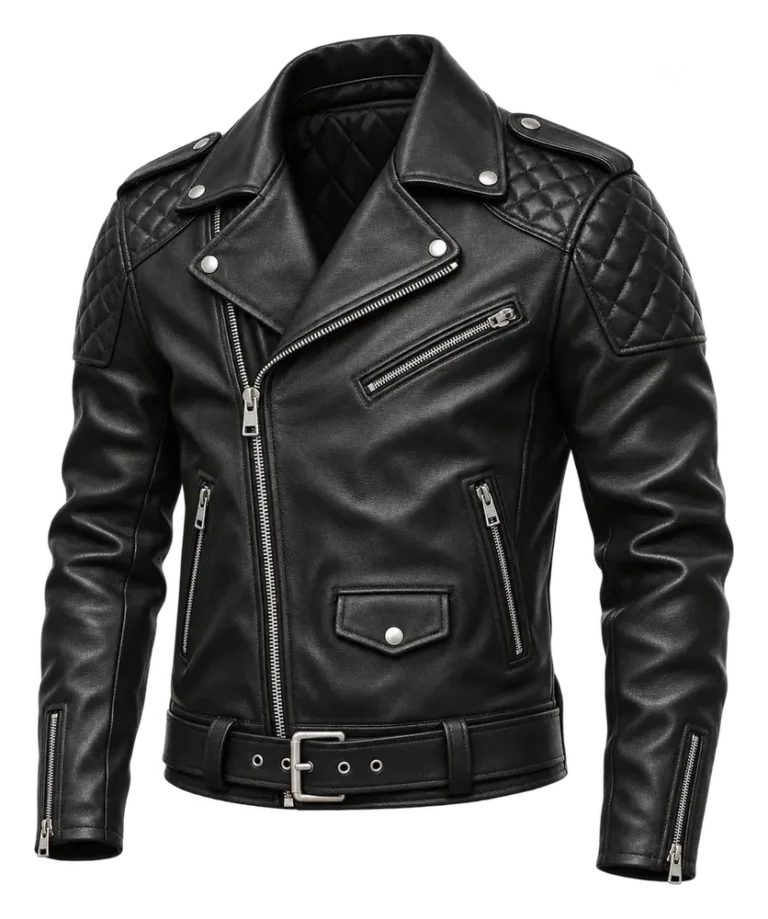
Features like diamond-quilted shoulder pads, accordion stretch panels on elbows, hand-waxed seams, or multi-pocket utility layouts require slower sewing speeds and higher operator skill than clean, minimal silhouettes.
Five Common Mistakes Small Brands Make on Their First Leather Order
- Ordering Too Many Styles at Once: Splitting your budget across four different jacket styles at the same time stretches your capital and complicates fit testing. Launch with one hero silhouette at 50 pieces, prove demand, and expand your leather jackets range on drop two.
- Choosing the Wrong Hide Thickness for the Silhouette: Putting a stiff 1.3 mm motorcycle cowhide into a softly draped fashion blouson will make the jacket feel rigid, while using ultra-thin 0.6 mm lambskin on a rugged work jacket risks seam tear under heavy wear. Always ask our team to match hide thickness (in mm) to the garment’s intended drape.
- Skipping Physical Sample Review: Approving a leather jacket from photographs alone means you cannot feel the weight, drape, or collar comfort. Always review a physical sample before greenlighting bulk production.
- Over-Complicating Custom Hardware on Run One: Custom-cast buckles with embossed logos add mould fees and extra lead time. Many smart emerging labels use clean, unbranded heavy gauge YKK hardware on their first 50-piece batch and invest in custom-moulded pulls once their core pattern is proven.
- Forgetting Packaging and Hangtag Presentation: A custom leather jacket needs proper wide-shoulder hangers or folded tissue protection so collars do not crease in transit, along with woven main labels, size tabs, and leather care cards ready for immediate customer dispatch.
Pre-Production Checklist for Small Leather Brands
Before requesting your formal production quote and tech pack free with order, gather the six items in the checklist below. Even if some technical details are still undecided, sharing your target retail price and aesthetic references allows our engineers to recommend the best hide and trim combination.
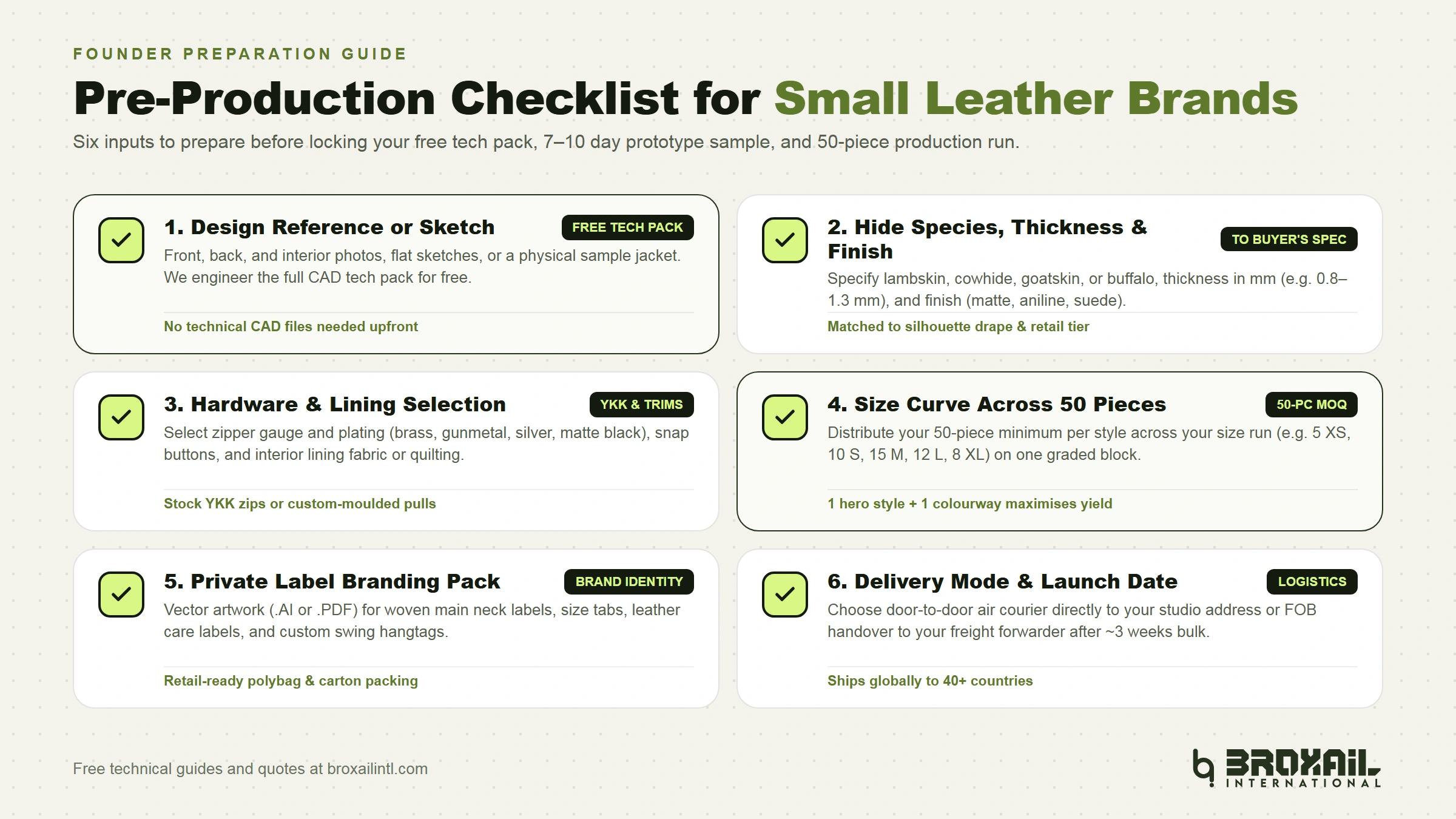
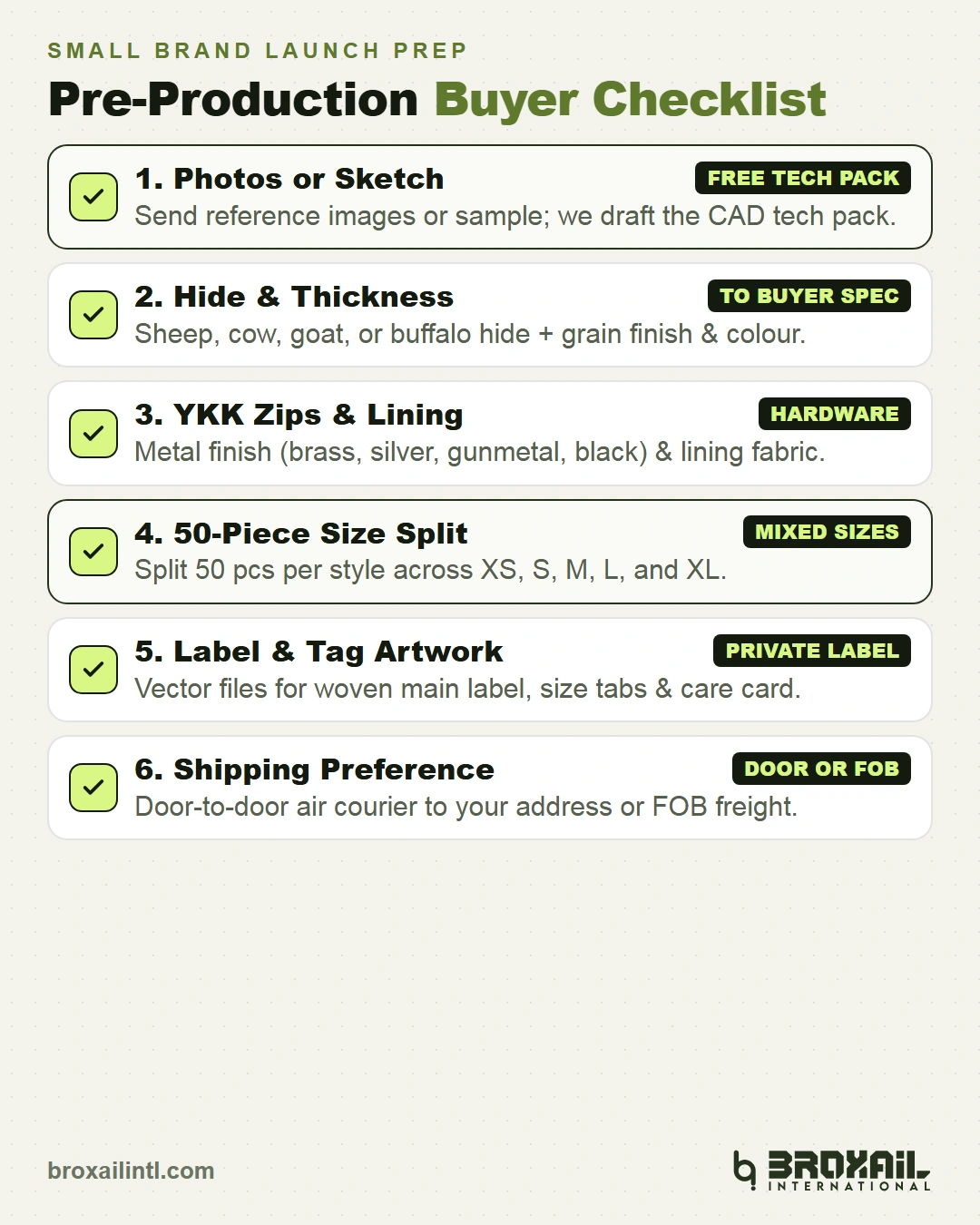
- Design Visuals: Clear front, back, and interior reference photos, flat sketches, or a physical benchmark garment.
- Hide & Finish Preference: Preferred animal skin (sheep, cow, goat, or buffalo), surface finish (matte, semi-aniline, distressed, suede), and colour reference (Pantone TPX/TCX or physical swatch).
- Lining & Trim Spec: Lining fabric preference, insulation weight if needed, zipper finish (brass, antique brass, gunmetal, silver, or matte black), and main woven label artwork.
- Size Breakdown: Your target size range and how you want to split your 50-piece MOQ across those sizes.
- Target Delivery Window: When you need samples in hand for photoshoot campaigns and when bulk stock must arrive at your warehouse.
- Shipping Preference: Whether you prefer hassle-free door-to-door courier delivery or FOB port/airport handover.
Door-to-Door vs FOB Shipping for Small Batch Orders
Shipping 50 leather jackets internationally does not require a freight forwarder on retainer. We offer two delivery structures tailored to your brand’s logistics setup:
- Door-to-Door Delivery (Preferred by Most New Buyers): We arrange export documentation in Pakistan, international air courier dispatch, and delivery straight to your studio, home warehouse, or 3PL fulfilment centre. This is the fastest, simplest route for 50 to 150 piece drops.
- FOB (Free on Board, preferred by larger brands): If you already work with a nominated freight forwarder or are consolidating multiple garment categories into a larger air or sea shipment, we deliver the finished cartons to the agreed Pakistani port or airport and hand over to your carrier.
Frequently asked questions
1. What is the minimum order quantity (MOQ) for custom leather jackets?
Our MOQ is 50 pieces per style and design. You can split those 50 pieces across multiple sizes (such as XS through XL) within the same style and colourway, making it practical for small and emerging brands to launch without excess inventory risk.
2. Do I need a professional tech pack before contacting BROXAIL?
No. BROXAIL includes a tech pack free with order, prepared by our in-house pattern engineers. You can send us reference photos, hand sketches, measurement notes, or a physical sample jacket, and we will translate your concept into a complete technical specification sheet for your approval before sampling begins.
3. How long does it take to get a custom leather jacket sample and bulk order?
Standard leather jacket samples take 7 to 10 days once the tech pack is approved. Complex styles, imported materials, or custom-made hardware and trims take longer depending on how complex the piece is. Once you receive and approve the sample, bulk production takes about 3 weeks.
4. Can I add my own brand labels, custom linings, and YKK zippers at 50 pieces?
Yes. All orders are manufactured as full private label to buyer’s spec. We attach your custom woven neck labels, size tabs, care labels, and hangtags, and you can specify genuine YKK metal zippers, custom lining colours, and branded snap buttons.
5. Which shipping option is best for a first order of 50 leather jackets?
Most new and small brands choose door-to-door delivery, where we arrange international air courier shipping directly from our Sialkot factory to your doorstep. Established brands that manage their own customs brokers and freight accounts can also book on FOB terms.
Ready to Build Your First Leather Jacket Collection?
You do not need a 500-piece budget or an in-house technical team to launch retail-grade leather outerwear. Send us your design references, target hide preference, and size breakdown on our Request a Quote page, and our engineering team will prepare your tech pack free with order and sampling plan.

Written by
Muhammad Abubakar
Muhammad Abubakar runs BROXAIL International, a custom leather and textile apparel manufacturer in Sialkot, Pakistan. He works with brands, labels and wholesalers from the first sample to delivery.